
Can you get pulled over for tint by itself, with no speeding and no broken taillight? Yes. In states where window film below the legal limit is a violation, an officer who reasonably believes your windows are too dark has grounds to stop the car for that alone. Dark front glass is also one of the few violations an officer can see from outside a moving vehicle, which is why tint stops are common. Understanding the standard officers work from makes the whole encounter less surprising and much shorter.
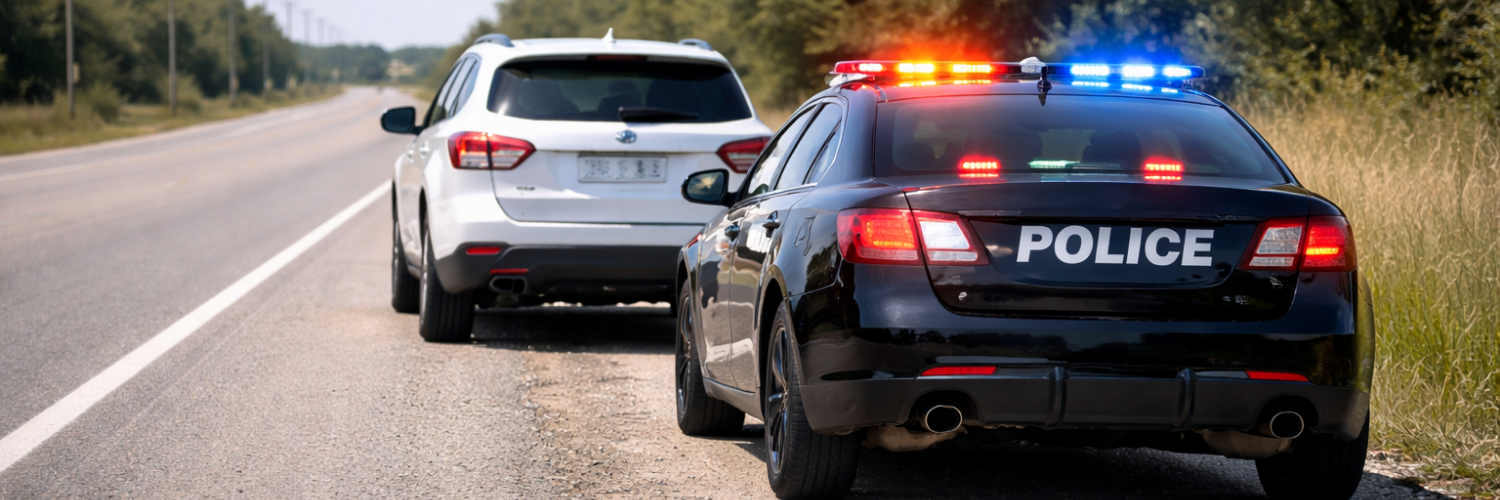
Can You Get Pulled Over for Tint Alone?
Yes, and the U.S. Supreme Court settled the underlying principle in 1996. In Whren v. United States, the Court held that “the temporary detention of a motorist upon probable cause to believe that he has violated the traffic laws does not violate the Fourth Amendment’s prohibition against unreasonable seizures, even if a reasonable officer would not have stopped the motorist absent some additional law enforcement objective,” per Whren v. United States, 517 U.S. 806 (1996). The Court added that “subjective intentions play no role in ordinary, probable-cause Fourth Amendment analysis.”
Translated into plain terms: if an officer has a legitimate basis to believe your tint violates state law, the stop is lawful, and the officer’s other reasons for wanting to talk to you do not make it unlawful. That is the legal reality behind the question of whether you can get pulled over for tint on its own.
What Gives an Officer Legal Grounds to Stop You for Tint?
An officer needs a reasonable, articulable suspicion that a tint violation is occurring, not proof, and not a meter reading at the roadside. New Jersey’s Supreme Court drew that line precisely in State v. Smith, 251 N.J. 244 (2022), holding that reasonable and articulable suspicion of a tinted window violation arises only when a vehicle’s front windshield or front side windows are so darkly tinted that police cannot clearly see people or articles within the car, as summarized in the New Jersey Law Revision Commission tentative report. The same report notes an earlier holding that an actual violation is not required to justify the stop, since suspicion of one suffices.
The safety rationale behind those rules is federal. Federal Motor Vehicle Safety Standard 205 requires at least 70% light transmittance in windows requisite for driving visibility on new passenger cars, and NHTSA states the purpose is “to ensure adequate visibility through the windows, thereby reducing the risk of a motor vehicle crash,” per this NHTSA interpretation letter. Officer safety is the second rationale, because an officer approaching a car wants to see hands.
| What draws an officer’s attention | Why it matters at a stop |
|---|---|
| Front side windows you cannot see through from outside | This is the classic standard: occupants and objects are not clearly visible |
| Tint on the windshield below the AS-1 line | Nearly every state restricts windshield film to a narrow top strip |
| Mirrored or metallic reflective film | Most states cap reflectivity separately from darkness |
| Bubbling, purple or peeling old film | Damaged film is visually obvious and invites a closer look |
| Out-of-state plates with very dark front glass | Limits differ by state, and no state must honor another state’s rules |
Can You Get Pulled Over for Tint in Another State?
Yes, and this is where drivers get caught out. Window tint limits are set state by state, so film that is legal at home can be a violation two states away, and no state is obligated to honor another state’s medical tint exemption. A driver with 20% front windows in a state that allows them can cross into a state with a 70% front-window rule and become a lawful stop without changing anything about the car. If you are unclear on what those percentages mean, our guide to what VLT means for window tint explains how the measurement works.
How Common Are Window Tint Stops?
Common enough that departments run dedicated enforcement pushes. Dearborn police in Michigan issued nearly 850 window tint citations in roughly three months, with Police Chief Issa Shahin explaining that dark tint “obstructs visibility for drivers, pedestrians and law enforcement officers alike” and noting that heavily tinted windows make it difficult to see inside a vehicle during a traffic stop, as reported February 28, 2025 by The Arab American News.
That is one city in one quarter. Tint is easy to spot at a distance, it does not require a radar unit, and it stays visible every day until the film or the paperwork changes. Drivers who assume a single citation was bad luck often learn otherwise on the same commute.
Does a Medical Tint Exemption Stop You From Being Pulled Over?
No. A medical window tint exemption does not prevent a stop, because the officer cannot see your paperwork from the patrol car, only your windows. Physician documentation for darker window tint does not guarantee you will not be stopped or cited, and officers retain discretion.
What the documentation changes is what you can show the officer. In states whose law provides a medical exemption, you can hand over the document that law describes, and in many states an agency-issued permit, certificate or decal backs it up. In states with no medical exemption, a physician recommendation has no legal effect and does not prevent a citation. Whether you are cited, and how a citation is resolved, is up to the officer and the court. You can read customer reviews of ForeverTint on Trustpilot.
According to Derek Anderson at ForeverTint: “Nothing stops an officer from seeing your windows, so the goal is to have the answer already sitting in your glove box.”
Want documentation written against your own state’s rules before your next drive? Contact Us Today, or start with See If You Qualify.
What Should You Do When You Are Pulled Over for Tint?
Make yourself visible immediately and keep the exchange short. Pull over promptly, roll the driver’s window fully down, turn on the interior light if it is dark, and put both hands on the wheel before the officer reaches the car.
When the officer asks for license and registration, say in one sentence that you also have a medical exemption for your window tint and tell them where the document is before reaching for it. Do not argue tint law at the roadside, do not claim the officer cannot cite you, and do not volunteer your full medical history. If you are cited anyway, keep the court date and bring the documentation with you. The full roadside routine, including what to do if you are cited, is in our guide to being pulled over with a tint exemption, and the paperwork itself is explained in what a medical window tint exemption is.
Frequently Asked Questions
Can police pull you over for window tint alone?
Yes. In states where tint below the legal limit is a violation, an officer who reasonably believes the front glass is too dark can stop the vehicle for that reason by itself. The Supreme Court held in Whren v. United States that a stop supported by probable cause of a traffic violation is reasonable regardless of the officer’s other motives.
How do officers know your tint is illegal before stopping you?
They usually do not measure first. The standard is reasonable suspicion, which courts have described as front windows so dark that people or objects inside the car are not clearly visible from outside. A meter reading typically happens after the stop, not before it.
Can you be pulled over for tint in a state you are only driving through?
Yes. Tint limits are set by each state, and film that is legal where you live can violate the law where you are driving. No state is required to honor another state’s medical tint exemption, so carry your documentation and expect officer discretion when you travel.
Does having a tint exemption prevent a traffic stop?
No. An officer sees your windows, not your paperwork, so a stop is still possible with valid documentation in the car. The exemption’s value is that it lets you show the officer, and a court if you are cited, the medical basis your state’s law recognizes. Officers and courts decide the outcome.
What should you say to an officer during a tint stop?
Say that you have a medical exemption for your window tint and that the documentation is in the glove box, then wait to be told to retrieve it. Keep your hands visible, keep the window fully down, and stay brief. The roadside is not the place to argue about visible light transmission percentages.
Conclusion
Can you get pulled over for tint? Yes, on its own, in any state where your film falls below the legal limit, and the standard officers use is reasonable suspicion rather than a measurement taken in advance. You cannot make dark windows invisible to enforcement, but you can be prepared: carry the documentation your state requires and keep the conversation short. If a medical condition is why you need sun protection, check what your state’s law allows and keep state-specific physician documentation in the vehicle. Contact Us Today and we will explain what your state requires.
This article is for general informational purposes and is not legal or medical advice. Physician documentation for darker window tint does not guarantee you will not be stopped or cited; officers retain discretion, and requirements vary by state.