
Drivers ask this constantly: how do police measure window tint, and how much does the number on the meter actually matter? The short answer is that an officer uses a small handheld tint meter that slides over the edge of the glass and reports visible light transmission in about a second. The critical detail is that the meter reads the factory glass and the aftermarket film together, not the film alone, which is why a film sold as 35% often measures closer to 26% once it is installed.
A tint meter is a calibrated optical instrument that shines a beam of visible light through a vehicle window and reports the percentage that passes through, a figure called visible light transmission, or VLT. Lower VLT means darker glass, and every tint citation comes down to that one number.
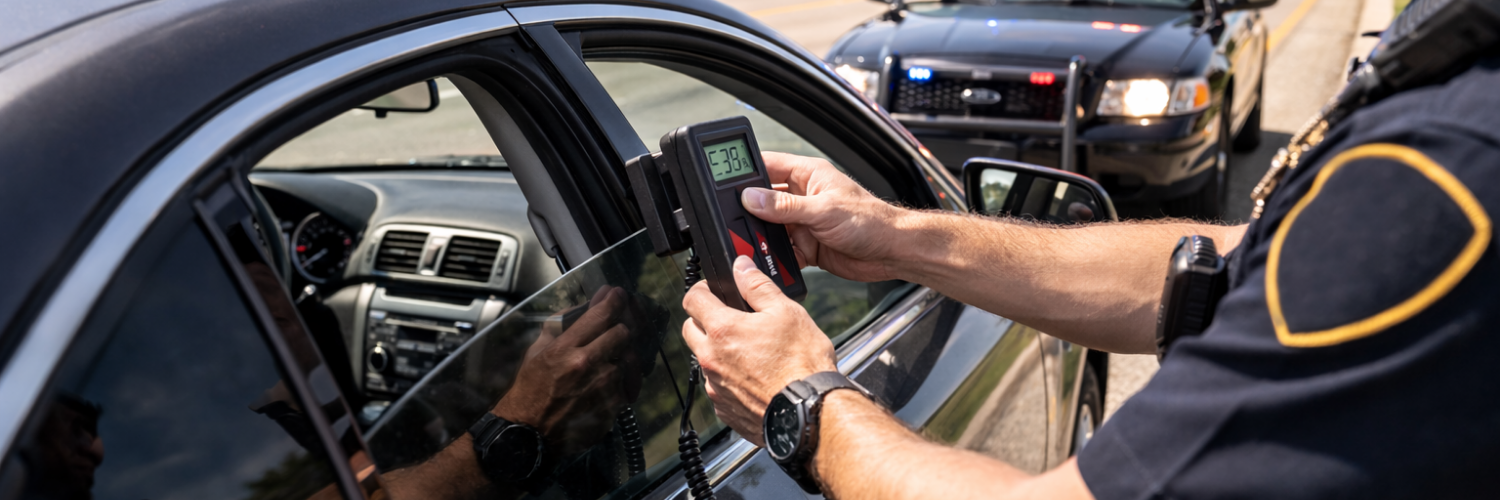
How Do Police Measure Window Tint at a Traffic Stop?
An officer measures window tint by lowering the window a few inches, sliding a handheld meter over the top edge of the glass so the light source sits on one side and the sensor on the other, then reading the VLT percentage off the display. The whole process takes a few seconds and does not require removing anything from the vehicle. Most agencies train officers to take the reading on the front side windows first, because those are where state limits are strictest.
The reading is taken on a clean, dry section of glass away from defroster lines, stickers and the dot matrix border, and officers are trained to avoid curved edges because the angle can distort the measurement. If the meter returns a number below the state threshold, that reading becomes the evidence written on the citation.
According to Derek Anderson at ForeverTint: “The meter does not care why your windows are dark, so the only thing that protects a driver with a medical need is paperwork signed before the stop, not an explanation given during it.”
How Accurate Is a Police Tint Meter?
Police tint meters are accurate to within a couple of percentage points, which is tight enough to hold up in traffic court but loose enough to matter if your tint sits near the legal line. The Enforcer II, one of the most widely deployed law enforcement models in the United States, is specified by its manufacturer Laser Labs as reading from 0% to 100% and being “accurate within plus or minus 2%,” using light at 550 nanometers with a 50 nanometer bandwidth and calculating a result in about one second.
That same meter ships with two reference samples traceable to the National Institute of Standards and Technology, the federal agency that maintains United States measurement standards, so an officer or an inspection station can verify the instrument against a known value. When a tint reading is challenged in court, calibration records are usually the first thing a judge asks about.
Accuracy still has limits. A meter reading 33% against a 35% limit sits inside the instrument’s own margin of error, and that is exactly the case where a driver may have a genuine argument. A meter reading 8% against a 35% limit is not close to any margin, and no amount of arguing about calibration will move it.
Does the Meter Read the Film or the Glass?
The meter reads both together, and this is the single biggest misunderstanding drivers have about tint enforcement. A 2020 technical paper from the European Window Film Association states plainly that transmission meters “will measure visible light passing through glazing, whether the glazing is only glass or glass and window film combined.” Your factory glass already blocks some light before any film is applied, so the installed result is always darker than the number printed on the film box.
The math is simple multiplication: the film’s rated VLT times the glass’s VLT gives the net reading. Federal Motor Vehicle Safety Standard 205 requires at least 70% light transmittance in windows requisite for driving visibility on new passenger cars, per NHTSA, so clear factory side glass sits in the mid to high 70s rather than at a perfect 100%.
| Film rating (VLT) | Net reading on 75% factory glass | Net reading on 80% factory glass | Clears a 35% state limit? |
|---|---|---|---|
| 70% film | 53% | 56% | Yes |
| 50% film | 38% | 40% | Yes |
| 35% film | 26% | 28% | No |
| 20% film | 15% | 16% | No |
| 5% film | 4% | 4% | No |
These figures are illustrative, since factory glass varies by vehicle and by window, but the pattern holds on every car. If you want a fuller explanation of the underlying measurement, read our guide to what VLT means in window tint.
How Do Police Measure Window Tint on the Windshield and Rear Windows?
Windshields are measured below the AS-1 line, the small manufacturer’s mark near the top of the glass, because almost every state allows tint only above that line or within the top few inches. Rear side windows and back glass are read the same way, but the legal threshold is usually far more permissive, and many states allow any darkness in the rear when the vehicle has dual side mirrors. Two-piece meters exist specifically so an officer can measure a fixed windshield or rear window where a clamp will not fit.
Is There a Legal Tolerance on a Tint Reading?
Several states write a tolerance directly into the statute, so the meter reading has to miss the limit by more than that margin before it is a violation. Texas Transportation Code Section 547.613(d) provides that a window complies if “the light transmission or luminous reflectance varies by no more than three percent from the standard,” against a requirement in Section 547.613(b) of “a light transmission of 25 percent or more.” Read the section at Justia.
Arizona builds the tolerance into the limit itself. Arizona Revised Statutes Section 28-959.01 sets the front side window standard as material “that has a light transmission of thirty-three percent plus or minus three percent,” also available at Justia. Many states publish a flat number with no stated tolerance, and there the officer’s reading is the reading, so check your own statute rather than assuming a cushion exists.
Can an Officer Cite You Without Using a Meter?
Yes, in many jurisdictions an officer can initiate a stop based on the visual appearance of the tint and cite based on observation, though a meter reading makes the citation far harder to contest. Tint is one of the few equipment violations visible from outside a moving vehicle, which is why it generates so many stops, and not every patrol vehicle carries a meter.
So two drivers with identical tint can see very different outcomes depending on who stops them. Physician documentation does not guarantee you will not be stopped or cited, because officers retain discretion. If you are cited, the court decides how much weight your documentation carries.
What Happens if Your Tint Reads Below the Limit?
If the meter reads below your state’s limit you will usually receive an equipment citation, and depending on the court you may be ordered to remove the film, pay a fine, or both. In states that allow it, a medical window tint exemption is the legal route to darker tint: physician-signed documentation stating that a diagnosed condition makes reduced light transmission medically necessary. Some states honor that document on its own, others require you to file it with an agency that issues a permit, certificate or decal, and some allow only clear UV film or removable shades or have no medical exemption at all.
Getting that documentation no longer requires an office visit. With the Medical Window Tint Exemption Package, you answer a short questionnaire and an independent licensed physician reviews your chart, occasionally with a brief phone call, with no video appointment and no in-person exam. If the physician determines you qualify, signed documentation is emailed the same day in most cases and within 72 hours at the outside. If the physician determines you do not qualify, you receive a full refund. Start with what a medical window tint exemption is, then See If You Qualify.
Frequently Asked Questions
Do all police officers carry a tint meter?
No. Tint meters are common in traffic units and at inspection stations, but not every patrol vehicle carries one. An officer without a meter can still stop a vehicle and cite based on observation in many jurisdictions, which is why identical tint can produce different outcomes with different officers. A meter reading, when one is taken, becomes the primary evidence on the citation.
Does a tint meter measure the film or the glass?
It measures both together. The meter reports the visible light transmission of the complete window, meaning the factory glass and any applied film as one unit. That is why a film rated at 35 percent typically measures somewhere in the middle 20s once installed on normal automotive glass. Always ask your installer what the net reading will be rather than what the film is rated at.
How accurate is a police tint meter?
Law enforcement meters are typically specified as accurate to within about two percentage points. The widely used Enforcer II model is listed by its manufacturer as accurate within plus or minus 2 percent across a 0 to 100 percent range, using a 550 nanometer light source and shipping with two reference samples traceable to the National Institute of Standards and Technology for verification.
Can you fight a tint ticket by challenging the meter?
Sometimes, particularly when the reading sits within a couple of points of the legal limit and calibration records are incomplete. Courts generally expect an officer to show the meter was checked against a reference standard. A reading far below the limit is very difficult to challenge on accuracy grounds, and drivers with a medical need can present physician documentation instead, though the court decides how much weight it carries.
Conclusion
So, how do police measure window tint? With a handheld meter that reads the glass and the film as one unit, accurate to roughly two percentage points, producing a single VLT number that decides the citation. Understanding that the net reading is always darker than the film’s printed rating explains most of the tickets drivers find surprising, and knowing whether your state writes in a tolerance tells you how much room you actually have. If a medical condition is the reason you need darker glass, get the documentation in place before the meter comes out. Contact Us Today.
This article is for general informational purposes and is not legal or medical advice. Physician documentation for darker window tint does not guarantee you will not be stopped or cited; officers retain discretion, and requirements vary by state.