
You did the hard part. The physician signed, the document arrived, and now you are standing at a counter trying to explain a piece of paper the installer may never have seen. Installing tint with a medical exemption is straightforward once both sides know what the document authorizes, but the conversation goes badly when a driver says “I have a medical exemption, go as dark as you can.” This is the version that works.
This guide covers exactly what to say, what to bring, what darkness to ask for, what to do if the shop has never handled one, and what to keep in the vehicle afterward.
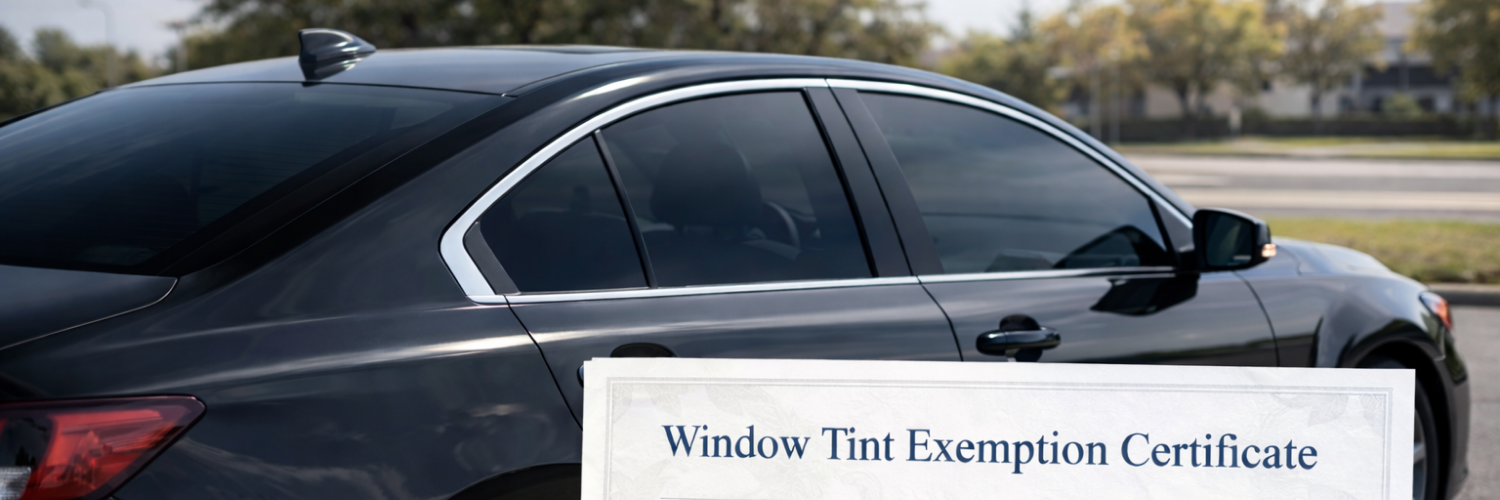
What Should You Tell the Shop When Installing Tint With a Medical Exemption?
Lead with three facts: the state you are registered in, the exact visible light transmission your documentation supports, and which windows it covers. That is the whole conversation from the installer’s side. A medical window tint exemption is physician-signed documentation permitting tint darker than your state’s standard limit because of a diagnosed medical condition, and it is not a blank check. The shop needs a number, not a story.
Bring the document itself rather than a description of it. Shops in several states are written into the tint statute directly, so an installer who cannot see paperwork is being asked to take the legal risk on your word. Handing over a copy answers the question before it is asked and usually turns a hesitant quote into a booked appointment.
A Checklist for Installing Tint With a Medical Exemption
| What to bring or say | Why the shop needs it |
|---|---|
| The signed physician document, plus the state permit, certificate or decal if your state issues one | It is the shop’s proof the job is compliant, and many will keep a copy with the work order |
| The registration state of the vehicle | Limits and exemption rules are set by the state that registers the car, not the state you are standing in |
| The visible light transmission your documentation supports | Film is ordered by percentage, and the shop cannot guess your ceiling |
| Which windows are covered: front sides, rear sides, rear window, windshield strip | Most exemptions apply to front side windows, and windshield rules rarely change |
| Whether the film needs to be ultraviolet-rejecting specifically | Ultraviolet rejection and darkness are separate specifications on the same film |
| Vehicle year, make, model and whether it already has factory privacy glass | Factory glass stacks with film, so the finished number is darker than the film alone |
| Ask the shop to apply any state-required compliance label | Some states penalize the installer for omitting it |
What Documents Should You Actually Bring to the Appointment?
Bring the physician document, your driver’s license, your vehicle registration, and any state-issued authorization your state requires. In physician-documentation states such as Texas, Ohio and Washington, the signed physician document is the whole package. In agency-approval states such as Florida, New Jersey, Georgia, North Carolina and Missouri, the state issues a permit, certificate, sticker or decal after reviewing the physician’s paperwork, and that is the item the shop and any officer will want to see. Some states do not allow darker film for medical reasons at all: Colorado, Hawaii, Iowa, Kansas, Kentucky, North Dakota, South Dakota and Utah have no medical exemption for darker tint, Kansas and Pennsylvania allow only clear UV-filtering film for medical reasons, and California allows only removable sun-screening devices with a physician’s letter or clear UV film with a dermatologist’s certificate.
Some states also require the driver to carry the authorization while driving, which makes the vehicle the right place to store it permanently. Virginia is explicit: the driver or an occupant must have the written authorization issued by the Commissioner of the Department of Motor Vehicles in his possession, under Virginia Code 46.2-1053. Keep the original in the glovebox and a photo on your phone as a backup.
Names matter more than people expect. Agencies typically require the name on the authorization to match the name on the registration and title, so a car titled to a spouse or a leasing company can create a mismatch that stops an application cold. Check that before the appointment rather than after.
What Darkness Should You Ask For?
Ask for the darkest film your documentation actually supports, and not one percentage point darker. Where a state sets its own limit for exempt vehicles it varies, for example 35% on Virginia’s side windows and 60% on New Jersey’s front side windows, and some states set none. Film applied past that ceiling is illegal again, which puts you back where you started with an extra removal bill attached.
Remember that glass and film stack. A window that already measures around 70% to 80% visible light transmission on its own will finish darker than the film’s rated number once the film is applied, and factory privacy glass on rear windows can finish far darker. A good shop measures the glass with a meter before quoting. The honest state-by-state ceiling is covered in the guide on how dark you can tint with a medical exemption.
According to Derek Anderson at ForeverTint: “The drivers who have the easiest appointments are the ones who walk in with a number, because the shop can order film against a number and cannot order film against a diagnosis.”
What If the Shop Has Never Installed for an Exempt Driver Before?
Expect some hesitation, and give the installer a reason to be comfortable rather than an argument. Many shops are cautious because their own state statute reaches them. Florida makes it a misdemeanor of the second degree for any person who sells or installs sunscreening material in violation of the state’s tint provisions, under Florida Statute 316.2956(3). Texas makes it a misdemeanor punishable by a fine not to exceed $1,000 for a business that places or attaches the material without installing the required compliance label between the film and the glass, under Texas Transportation Code 547.613(a-1).
Offer a copy of your documentation for their file, ask them to apply the compliance label your state requires, and let them measure the finished windows with a meter so the work order records the result. If the shop still declines, that is their call to make, and another shop will take the job. Some shops go further and refer customers for documentation themselves, earning a referral payment through the ForeverTint Affiliate Program, so it is worth asking whether your installer already works with an exemption provider.
What Should You Do After the Film Is On?
Keep the documentation in the vehicle at all times, not in a drawer at home. The document only works if it is with you when an officer asks, and the most common failure mode ForeverTint hears about is a driver who has a valid exemption sitting on a kitchen counter. Store the original in the glovebox, photograph it, and keep the photo somewhere you can find it quickly.
Photograph the finished car and keep the work order, including the film brand and the measured visible light transmission. If your state issues a sticker or decal, make sure it is placed where the state specifies rather than wherever it looks tidy. Watch the expiration date too, because terms range from one year to permanent depending on the state, and Tint Exemption Renewals are available in one-year, three-year and ten-year terms.
Finally, be realistic about traffic stops. Physician documentation for darker window tint does not guarantee you will not be stopped or cited, because officers retain discretion. If you are cited, what happens next is up to the court. What to do in the moment is covered in the guide on being pulled over with a tint exemption. Questions before your appointment? Contact Us Today.
Frequently Asked Questions
Do tint shops have to honor a medical exemption?
No. A shop can decline any job for any reason, and some decline darker installations as a matter of policy because several states write installers into the tint statute. Bringing your documentation, your state’s authorized visible light transmission number and a willingness to let them label and measure the work removes most of the hesitation.
Can I tint my windshield with a medical exemption?
Almost never for the full windshield. Most states allow tint only above the AS-1 line or within the top four to six inches, and a medical exemption rarely changes that rule. Exemptions usually apply to the front side windows, which is where standard limits cause the most difficulty for light-sensitive drivers.
What visible light transmission should I ask the shop for?
Ask for the exact number your documentation and your state authorize, which varies by state and is often lighter than the very dark numbers drivers imagine. Going darker than the authorized figure makes the vehicle non-compliant again. A shop with a tint meter can confirm the finished reading before you leave.
Should the shop keep a copy of my exemption paperwork?
It is good practice, and many shops now request one. A copy in the work order shows the business installed against valid documentation, which matters in states where the installer carries its own exposure. It costs you nothing and makes future work at the same shop easier.
Does factory privacy glass count toward my legal limit?
Yes, because measurements are taken through the glass and film together rather than the film alone. A rear window with factory privacy glass around 15% to 20% visible light transmission will finish far darker once film is added. Most states apply looser rules behind the driver, but your installer should still measure rather than estimate.
Conclusion
Installing tint with a medical exemption is a short, easy appointment when you arrive with the document, the state, the number and the list of covered windows. Bring the paperwork, ask for the darkness your authorization actually supports, let the shop label and measure the work, and keep the original in the vehicle afterward. Start with the overview of what a medical window tint exemption is if you are still deciding, or Contact Us Today with questions about your appointment.
This article is for general informational purposes and is not legal or medical advice. Physician documentation for darker window tint does not guarantee you will not be stopped or cited; officers retain discretion, and requirements vary by state.