
Dermatologists have a name for the tan that only shows up on one arm, and the pattern behind it is not folklore. In the United States, where the driver sits on the left, skin cancers turn up on the left side of the body more often than the right, and left side skin cancer from driving is the explanation researchers keep landing on. The cause is not the sun you feel on a beach. It is the UVA coming through the window beside your shoulder on every commute.
This guide covers what the national cancer data actually shows, why the driver’s side gets more ultraviolet than the passenger’s side, who carries the most exposure, and what a driver can do about it.
Is Left Side Skin Cancer From Driving a Real Pattern?
Yes. The left-side skew is a documented asymmetry in United States cancer registry data, not an anecdote. University of Washington researchers analyzed 82,587 melanomas and 2,384 Merkel cell carcinomas in the federal Surveillance, Epidemiology, and End Results registry and found both cancers were significantly more likely to arise on the left side of the body than the right. Overall, 52% of melanoma cases and 53% of Merkel cell carcinoma cases appeared on the left, according to the 2011 Journal of the American Academy of Dermatology study indexed on PubMed and reported by TIME in June 2011.
A few percentage points sounds small until you remember what the comparison is. Left and right sides of a body get the same genetics, the same age and the same immune system. There is no biological reason either side should carry more cancer. An environmental exposure has to be doing the work, and the authors pointed at one: driver-side ultraviolet exposure, which they measured as roughly five times stronger on the left arm than the right.
What the SEER Data Says About Left Side Skin Cancer From Driving
| Cancer type | Body site | Share occurring on the left side |
|---|---|---|
| Melanoma | All sites combined | 52% |
| Melanoma | Arm | 53% |
| Melanoma | Leg | 52% |
| Melanoma | Face | 51% |
| Merkel cell carcinoma | All sites combined | 53% |
| Merkel cell carcinoma | Arm | 55% |
| Merkel cell carcinoma | Face | 52% |
Figures are from the 2011 SEER analysis cited above. The effect is strongest on the arm, which is the part of the body that spends the most time directly in the window, and weakest on the leg, which spends the most time under the dashboard. That gradient is what makes the driving explanation persuasive rather than coincidental.
Why Does the Driver’s Left Side Get More Ultraviolet Than the Right?
The driver’s left side gets more ultraviolet because the glass beside it barely filters UVA, while the glass in front of it does. Windshields are laminated, with a plastic interlayer bonded between two sheets of glass, and that interlayer absorbs almost all ultraviolet A. Side windows are single-pane tempered glass with no interlayer, because they need to shatter safely and break out in an emergency. Safety engineering wins, and ultraviolet protection loses.
The measurements are consistent. Across 29 vehicles from 15 manufacturers, front windshields blocked an average of 96% of UVA while side windows blocked only 71%, and only 4 of the 29 vehicles had side windows blocking more than 90%, per Boxer Wachler’s 2016 study in JAMA Ophthalmology. A 2025 replication across 34 gas, hybrid and electric vehicles in Archives of Dermatological Research found windshields attenuating 99.25% of UV-A against 88.78% at the driver-side window, a statistically significant gap that held across drivetrains.
UVB, the wavelength that produces a visible sunburn, is absorbed almost completely by automotive glass. That is precisely why driver-side damage accumulates unnoticed. Nothing stings, nothing turns red, and the damage is cumulative UVA that shows up decades later. The full breakdown of the glass measurements is in the guide to how much UV gets through car windows.
Who Carries the Most Driver-Side Sun Exposure?
People who drive for a living carry the most driver-side sun exposure, followed by long commuters. Delivery drivers, truckers, rideshare and taxi drivers, sales reps, contractors and anyone logging several hours a day behind the wheel accumulate ultraviolet on the left arm, left shoulder, left cheek and left hand year after year. Dermatology literature includes a well-known case of a delivery driver whose left face showed decades more photoaging than his right after 28 years on the route.
The background risk is already significant. The American Academy of Dermatology reports on its skin cancer statistics page, updated March 2026, that one in five Americans will develop skin cancer in a lifetime, that approximately 9,500 people in the United States are diagnosed with skin cancer every day, and that the majority of melanoma cases are attributable to ultraviolet exposure. Add an occupational left-side dose on top of that baseline and the asymmetry in the registry data stops being surprising.
Does Window Tint Reduce the Ultraviolet That Causes Left-Side Damage?
Yes, and it is the single most effective fix available to a driver. Quality window film blocks ultraviolet regardless of how dark it looks, because ultraviolet rejection and visible darkness are separate specifications. The Skin Cancer Foundation states that UV window film “can block more than 99% of UVA and UVB light,” and its Seal of Recommendation requires 99% or more UVA and UVB blocking, on the foundation’s UV window film page.
That means a nearly clear film can solve the ultraviolet half of the problem inside almost every state’s legal limit. Darkness is a separate question, and it matters when a physician determines that reduced visible light is medically appropriate, which is common for photosensitivity, photophobia, lupus and drug-induced sun sensitivity. Sunscreen on the left arm, a long sleeve and sunglasses cover the rest of the gap. Always consult with your healthcare provider about your condition; only a licensed physician can determine whether darker window tint is medically appropriate for you.
Can a Skin Cancer History Qualify You for a Medical Tint Exemption?
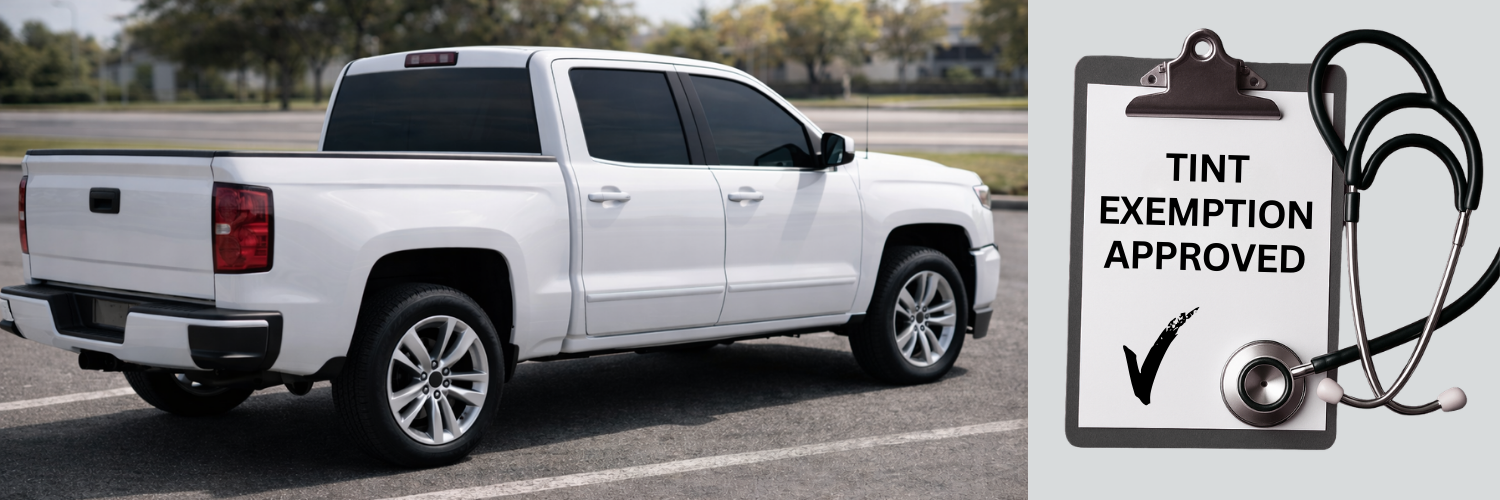
A skin cancer history is one of the conditions physicians review for a medical window tint exemption, which in most states that offer one is physician-signed documentation permitting tint darker than your state’s standard limit because of a medical condition. Melanoma and other skin cancers are among the conditions physicians consider, alongside lupus, photosensitivity dermatitis, xeroderma pigmentosum, albinism, porphyria, vitiligo and autoimmune conditions. Rules vary by state: Colorado, Hawaii, Iowa, Kansas, Kentucky, North Dakota, South Dakota and Utah have no medical exemption for darker tint, Kansas and Pennsylvania allow only clear UV-filtering film for medical reasons, and California allows only removable sun-screening devices with a physician’s letter or clear UV film with a dermatologist’s certificate. The full list is in the guide to medical conditions that qualify for a window tint exemption, and qualification is always a physician’s call on your individual case.
According to Derek Anderson at ForeverTint: “The left-side pattern in the cancer registry is the most concrete evidence we have that a car window is not the sun protection people assume it is.”
ForeverTint handles the paperwork online. You answer a questionnaire, See If You Qualify for your state, and an independent licensed physician reviews your chart, occasionally with a brief phone call. There is no video visit and no in-person exam. If you qualify, your documentation is emailed, usually the same day and within 72 hours; in Florida, the physician-signed Form HSMV 83390 is provided to you to submit to the FLHSMV. If the physician determines you do not qualify, you receive a full refund. Questions about your own history? Contact Us Today.
Frequently Asked Questions
Can you really get skin cancer from driving?
Driving does not cause skin cancer by itself, but the ultraviolet A exposure through side glass is a genuine contributor to lifetime risk. National registry data shows melanoma and Merkel cell carcinoma occurring more often on the left side of the body in the United States, which matches the driver’s seat position. The risk builds over years rather than single trips.
Why is my left arm more tanned or damaged than my right?
Your left arm sits next to a side window that blocks only about 71% of UVA on average, while the windshield in front of you blocks about 96%. That difference means the left arm collects several times more ultraviolet A during driving than the right. Over years it shows as darker pigment, more freckling and more photoaging on one side.
Do I need sunscreen while driving?
Dermatologists generally say yes, especially on the left arm, left hand and left side of the face, and especially for anyone who drives for a living. Automotive glass stops most UVB but lets substantial UVA through the side windows. Sunscreen, long sleeves and ultraviolet-blocking window film all reduce that exposure.
Do the rear windows protect passengers better than the front?
Sometimes, because many SUVs, vans and trucks have factory privacy glass in the rear that is darker than the front side windows. Performance still varies by manufacturer, and privacy glass is not engineered as an ultraviolet barrier. The driver’s own window remains the least protected piece of glass in most vehicles.
Does a medical tint exemption cover skin cancer survivors?
Melanoma and other skin cancer histories appear on the condition lists physicians review, but no service can promise approval because the decision belongs to the licensed physician evaluating your case. If the physician determines darker tint is medically appropriate, you receive state-specific documentation to keep in the vehicle. If the physician determines you do not qualify, the fee is refunded.
Conclusion
Left side skin cancer from driving is what happens when a body spends thousands of hours next to glass that stops only about 71% of UVA. The fix is not complicated: ultraviolet-rejecting film on the side windows, sunscreen on the left arm, and a conversation with your dermatologist if you already have a history. For drivers whose condition also makes ordinary light and glare hard to tolerate, physician-signed documentation is the legal route to darker film in states that allow it. Start with the overview of what a medical window tint exemption is, or Contact Us Today.
This article is for general informational purposes and is not legal or medical advice. Physician documentation for darker window tint does not guarantee you will not be stopped or cited; officers retain discretion, and requirements vary by state.