
A medical tint exemption cost in 2026 is usually one flat, all-inclusive fee for the physician review and the state-specific paperwork, plus a separate state application fee in states that issue a permit or decal. The ForeverTint package is listed at 199 dollars, with current promotions shown on the purchase page, and it is refunded in full if the physician determines you do not qualify. The more useful question is how that compares with a tint ticket and its court costs, or with stripping film off your windows and paying to reinstall legal film.
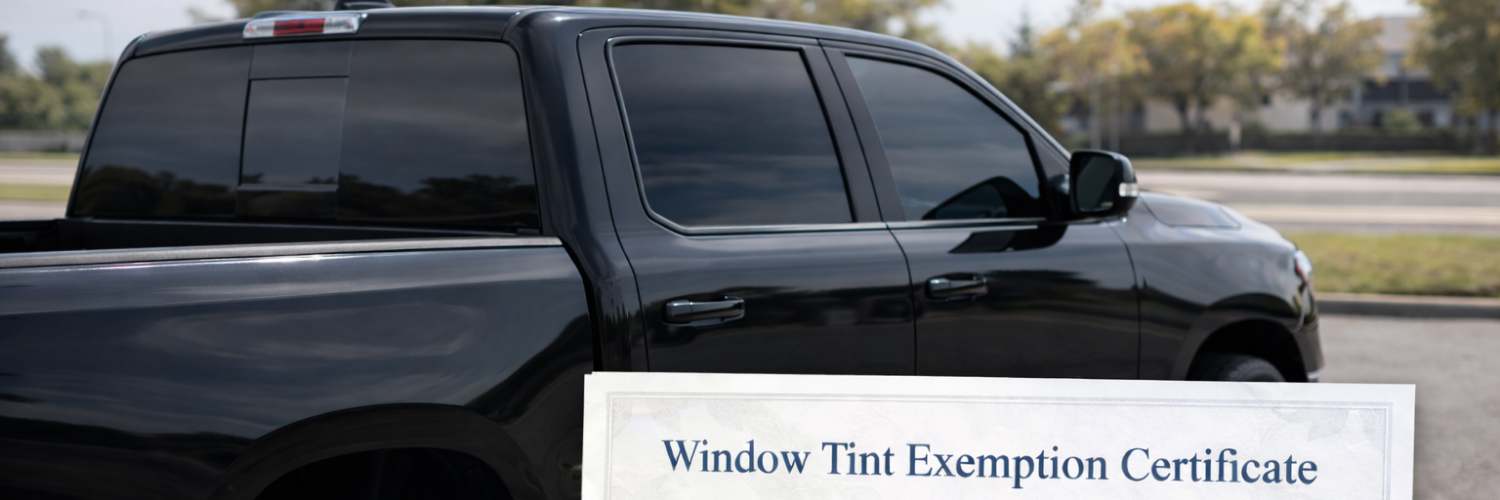
How Much Does a Medical Tint Exemption Cost in 2026?
Budget one flat fee for the physician review and documentation, plus any state agency fee your state charges. There is no per-window pricing, no consultation charge separate from the document, and no recurring fee until your state’s renewal period comes around.
The Medical Window Tint Exemption Package is sold per state at a 199 dollar list price, with current promotions on the purchase page. That single fee covers the questionnaire, the physician chart review or a brief 2 to 10 minute phone verification, the signed state-specific document, and delivery by email, or by mail in Florida where physical signatures are required. If the physician determines you do not qualify, you get a full refund, and ForeverTint reports that only about 1 in 50 applicants is not approved after review, with more than 20,000 patients served as of 2026.
State fees are separate and small by comparison. Georgia requires an application, a payment, and the physician letter on official letterhead mailed directly from the medical office to the Department of Public Safety, per the Georgia Department of Public Safety. Physician-document states such as California, Texas and Pennsylvania charge nothing, because there is no agency to file with.
Exemption vs. Tint Ticket vs. Tint Removal: What Does Each Option Cost?
The exemption is almost always the cheapest of the three, because a ticket is rarely a single number and removal is money spent to get less of what you paid for. Here is how the three choices compare. Tint removal and reinstall figures are typical shop-quoted ranges rather than statutory amounts, so treat them as planning estimates and get a local quote.
| Option | Typical out-of-pocket | What you end up with | What you still risk |
|---|---|---|---|
| Medical tint exemption | One flat fee, 199 dollars list with promotions on the purchase page, plus any state application fee | Signed physician documentation, and a state permit or decal where the state issues one | Officers retain discretion, so a stop or citation is still possible |
| Tint ticket plus court costs | Statutory fine plus mandatory add-ons, which can multiply the base amount several times over | A paid citation, and the tint is still illegal on your car | Repeat stops, repeat citations, and in some states an escalating penalty class |
| Tint removal and reinstall | Typical shop ranges of roughly 100 to 250 dollars to strip a full vehicle, then the cost of new legal film | Compliant windows, and noticeably more sun and glare in the cabin | Your underlying light sensitivity is unaddressed, and adhesive residue or defroster damage is possible |
According to Derek Anderson at ForeverTint: “Drivers almost always compare our fee to nothing, when the honest comparison is one flat fee against a ticket you may pay more than once, or against paying a shop to remove film you already bought.”
Want help working out which column applies to your state? Contact Us Today before you pay a ticket or book a removal.
How Much Is a Window Tint Ticket, Really?
A window tint ticket costs far more than its base fine, because states bolt mandatory court costs and assessments onto every citation. The base number on the ticket is the starting point, not the total.
Florida makes this unusually easy to see. Florida Statute 318.18 sets 30 dollars for all nonmoving traffic violations, then adds 18 dollars in court costs for nonmoving infractions, a 12.50 dollar administrative fee, a 10 dollar Article V assessment, county surcharges of up to 30 dollars for state court facilities, and municipal surcharges of up to 15 dollars, per the 2024 Florida Statutes. A 30 dollar fine can end up near 115 dollars once those stack, and that is for one citation on one day.
Other states treat illegal tint as a criminal matter rather than a fee. Virginia Code 46.2-1052 makes an unlawful tint application a Class 3 misdemeanor for a first offense and a Class 2 misdemeanor for any subsequent offense, per the Code of Virginia. Virginia Code 18.2-11 sets a Class 3 misdemeanor at a fine of not more than 500 dollars, and a Class 2 misdemeanor at confinement in jail for not more than six months and a fine of not more than 1,000 dollars, either or both, per the Code of Virginia. One Virginia repeat offense can cost twice what a decade of exemption paperwork costs.
Is It Cheaper to Just See Your Own Doctor?
Seeing your own doctor is sometimes cheaper and sometimes not, and the deciding factor is usually your deductible rather than your copay. Many drivers assume insurance makes the visit free, then discover it lands against a deductible they have not met.
The 2025 KFF Employer Health Benefits Survey reported that the average copayment for a primary care visit is 27 dollars, while the average general annual deductible for workers with single coverage is 1,886 dollars, per KFF. If your deductible is unmet, the visit is billed closer to full price than to 27 dollars. Add time off work and travel, and the gap narrows quickly.
There is a second cost that never shows on an invoice. A general practice letter written without reference to your state’s form can be rejected, which means paying for a second visit. Georgia, for instance, will not accept a letter the patient hands in themselves.
What Other Costs Should You Plan For?
Plan for three things beyond the exemption itself: your state’s renewal cycle, the film you actually install, and the cost of doing nothing. Each one is predictable if you look at it before it arrives.
Renewal cycles vary widely. New Jersey permanent approvals run 48 months, per the New Jersey Motor Vehicle Commission, while Alaska and Indiana expect annual recertification. Tint Exemption Renewals come in 1-year, 3-year and 10-year terms with no re-qualification, which is how drivers in short-cycle states avoid paying repeatedly.
The cost of doing nothing is the one people underrate. A 2016 study in JAMA Ophthalmology found front windshields blocked an average of 96 percent of UVA light while side windows blocked only 71 percent, with a range as wide as 44 to 96 percent, per Boxer Wachler, JAMA Ophthalmology, 2016. University of Washington researchers reported in the Journal of the American Academy of Dermatology in 2011 that 52 percent of melanomas and 53 percent of Merkel cell carcinomas in a federal cancer database occurred on the left side of the body, consistent with driver-side exposure, as reported by TIME. Always consult with your healthcare provider about your condition; only a licensed physician can determine whether darker window tint is medically appropriate for you.
Frequently Asked Questions
What is the total medical tint exemption cost including state fees?
Expect one flat fee for the physician review and documentation, listed at 199 dollars with current promotions on the purchase page, plus any application fee your state charges. Physician-document states such as California, Texas and Pennsylvania charge no state fee because there is nothing to file. States that issue a permit or decal, including Georgia, require their own payment with the application.
Is a medical tint exemption cheaper than a tint ticket?
Usually yes, especially after court costs. Florida adds court costs, an administrative fee, an Article V assessment and county or municipal surcharges on top of a 30 dollar nonmoving violation. Virginia treats unlawful tint as a Class 3 misdemeanor punishable by a fine of up to 500 dollars, rising to a Class 2 misdemeanor for later offenses.
Do I get my money back if I do not qualify?
Yes. The fee is refunded in full when the physician determines a driver does not qualify. ForeverTint reports that only about 1 in 50 applicants is not approved after physician review, so the review itself carries no financial risk.
How much does it cost to renew a medical tint exemption?
Renewal pricing depends on the term you choose, and renewals are available in 1-year, 3-year and 10-year options with no re-qualification and no additional physician consultation required. Because renewal cycles differ by state, from annual recertification in Alaska and Indiana to 48 months in New Jersey, a longer term often costs less over time.
Conclusion
The medical tint exemption cost in 2026 is one flat, all-inclusive fee plus any state application fee, refundable if a physician determines you do not qualify. Measured against a ticket that arrives with mandatory court costs attached, against a repeat offense that can escalate to a higher penalty class, or against paying a shop to strip film you already bought, the exemption is the cheapest realistic option and the only one that addresses the underlying medical need. To find out what your state charges, Contact Us Today, or read the background in our guide to what a medical window tint exemption is.
This article is for general informational purposes and is not legal or medical advice. Physician documentation for darker window tint does not guarantee you will not be stopped or cited; officers retain discretion, and requirements vary by state.