
If you are pulled over with tint exemption paperwork in the car, stay in your seat, keep your hands visible, and produce the documentation only when the officer asks for your license and registration. A medical tint exemption is physician documentation that darker window tint is medically necessary for you, and at a traffic stop its whole job is to be produced quickly and calmly. Officers retain discretion, so documentation does not guarantee you will not be cited. What it does is give the officer, and later a court, a legitimate reason to let the tint go.
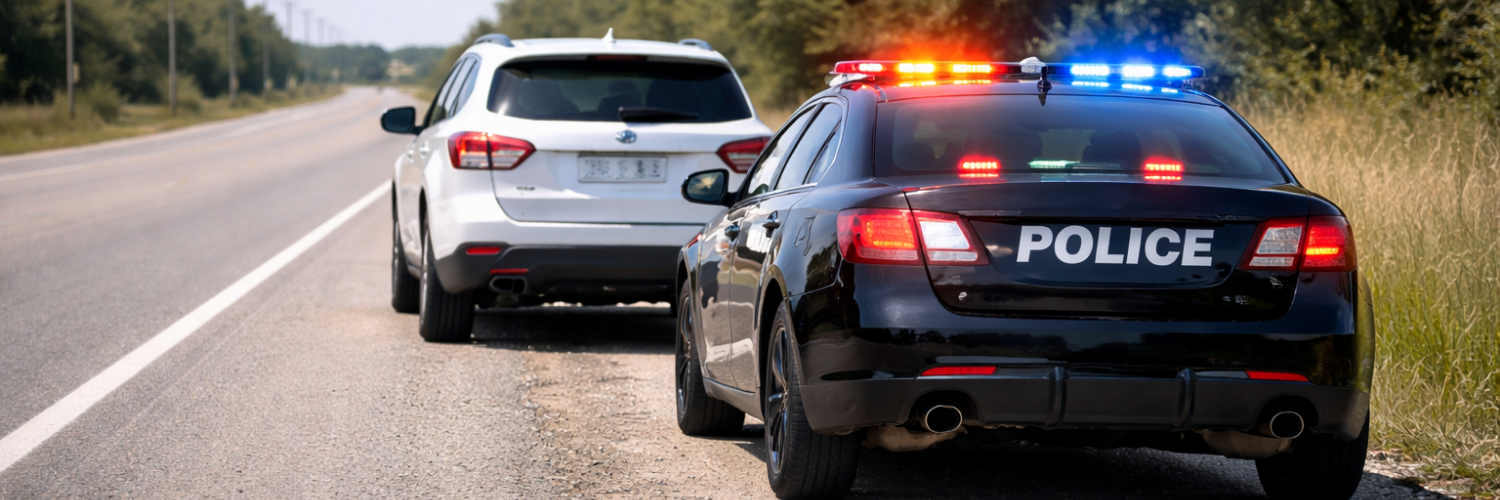
What Should You Do First When Pulled Over With Tint Exemption Paperwork?
Pull over promptly, roll the driver’s window fully down, turn on your interior dome light if it is dark, and put both hands on the wheel. Dark windows are an officer-safety concern before they are a legal one, so removing the visibility problem yourself changes the tone of the stop immediately.
Wait for the officer to speak first. When they ask for license and registration, say that you also have a medical tint exemption document and tell them where it is before you reach for it. Reaching into a glove box unannounced during a tint stop is the single most avoidable mistake a driver can make.
Keep the exchange short. You are not there to argue tint law at the roadside, and the officer is not the person who decides whether your paperwork ultimately holds up. Hand it over, answer what you are asked, and let the document speak.
Where Should You Keep Your Medical Tint Exemption Document?
Keep the original in the vehicle at all times, in the glove box or door pocket, with a backup photo on your phone. A tint exemption you cannot produce at the roadside functions exactly like no exemption at all.
States say this outright. The New Jersey Motor Vehicle Commission instructs drivers to keep the approval document in the vehicle at all times and to show it whenever requested by law enforcement as well as for vehicle inspection purposes, per the New Jersey Motor Vehicle Commission. California Vehicle Code section 26708(b)(10) frames the requirement as having the physician or optometrist letter in your possession, per the 2025 California Vehicle Code. Virginia Code section 46.2-1053 requires the driver to possess the DMV Commissioner’s written authorization while operating the vehicle, per the Code of Virginia.
Two practical habits help. Keep the paper copy flat in a clear sleeve so it survives years in a glove box, and if your state issues a sticker or decal, make sure it is actually applied where the state says. Florida medical exemption certificates carry a vehicle description, VIN and decal number, per Florida Statute 316.29545, which is only useful if the decal is on the car.
What Should You Say to the Officer?
Say one clear sentence: you have a medical exemption for your window tint, and the documentation is in the glove box. That is the whole script. Volunteering your diagnosis, quoting statute numbers, or explaining how you got the exemption online adds nothing and can make the stop longer.
If the officer asks follow-up questions, answer them plainly. If they ask about your condition, you can say a licensed physician determined you need protection from sunlight without reciting your medical history. You are allowed to be private about the details while still being cooperative.
What Not to Say When Pulled Over With Tint Exemption Documents
Do not tell the officer they cannot cite you. Do not argue that your paperwork makes the tint legal in every state. Do not claim your exemption is in a database they should be able to look up, because in most states nothing like that exists. Each of those moves turns a two-minute stop into an adversarial one, and none of them changes the outcome in your favor.
Can an Officer Still Write You a Ticket?
Yes. An officer can still write a citation even with valid documentation in hand, because the exemption generally operates as a legal defense rather than as immunity from being charged. Understanding that distinction is what keeps a stop from becoming an argument.
Texas states the mechanics plainly. Transportation Code section 547.613(e) provides that it is a defense to prosecution that the defendant or a passenger in the vehicle at the time of the violation is required for a medical reason to be shielded from direct rays of the sun, per the 2025 Texas Statutes. A defense to prosecution is something you raise after a charge, not something that prevents one. Texas goes further: its own inspection notice tells stations to advise owners that passing inspection “does not foreclose potential prosecution under Transportation Code Section 547.613,” per the Texas Department of Public Safety.
So the honest framing is this: physician documentation for darker window tint does not guarantee you will not be stopped or cited, and officers retain discretion. In ForeverTint’s experience, drivers who bring their documentation to court often have tickets dismissed, and Trustpilot reviewers describe using their paperwork successfully at stops, with ForeverTint holding a 4.3 out of 5 TrustScore from 33 reviews as of September 2026 on Trustpilot. According to Derek Anderson at ForeverTint: “Your documentation is not a force field at the roadside, it is evidence, and evidence is what wins in court.”
Questions about what your state’s paperwork actually does at a stop? Contact Us Today.
What Should You Do If You Get Cited Anyway?
Do not pay the ticket, and do not miss the court date. Paying a tint citation is generally an admission that ends the matter, which forfeits the one place your documentation carries the most weight.
Take five steps instead. Photograph the citation and note the officer’s stated reason. Make copies of your physician documentation and any state permit, certificate or decal paperwork. Check whether your state treats tint as a correctable violation, since some jurisdictions dismiss on proof of compliance or valid exemption. Appear on the date listed and present the documentation to the court rather than arguing it at the roadside. If your state issues a permit and yours has lapsed, renew it before the hearing.
What you show the court depends on your state’s mechanism, and the difference matters more than most drivers realize.
| Your state’s mechanism | What you show at a stop | What you take to court |
|---|---|---|
| Physician document only, no state filing (for example California, Texas, Pennsylvania, Ohio) | The signed physician or optometrist letter, carried in the vehicle | The same signed letter, plus proof the provider is licensed |
| Physician document plus state approval (for example Florida, New Jersey, Georgia, North Carolina) | The state-issued permit, certificate or approval document, and the decal or sticker if one was issued | The state approval plus the underlying physician documentation |
| No formal state program | The physician-issued window tint recommendation as supporting documentation | The recommendation, presented as medical evidence of necessity |
Frequently Asked Questions
What should I say to the officer during a tint stop?
Say that you have a medical exemption for your window tint and that the documentation is in the glove box, then wait for the officer to tell you to retrieve it. Keep your hands visible, roll the window fully down, and avoid arguing tint law at the roadside. Short and cooperative is the goal.
Does a medical tint exemption stop the police from pulling me over?
No. Dark tint is a visible condition, so an officer can initiate a stop regardless of what paperwork you hold. Documentation does not prevent a stop or guarantee you avoid a citation, because officers retain discretion. Its value is in resolving the stop quickly and in supporting you if the matter reaches court.
Is my exemption in a database the officer can look up?
In most states there is no roadside database for tint exemptions, which is why carrying the paper document matters. Some states that issue a permit, sticker or decal give the officer a visible marker on the vehicle, but the underlying paperwork should still be in the car.
Will my exemption work if I am pulled over in another state?
Not necessarily. No state is obligated to honor another state’s medical tint exemption, so treat out-of-state travel as officer discretion rather than protection. Carry the documentation anyway, and check the rules for any state where you spend significant time.
Should I pay a tint ticket if I have valid documentation?
Generally no, because paying is usually treated as an admission and closes the case. Appear on your court date and present the physician documentation along with any state permit or certificate. In ForeverTint’s experience, drivers who bring their documentation to court often have tickets dismissed, though no outcome can be promised.
Conclusion
Being pulled over with tint exemption paperwork is a manageable two-minute event if you prepare for it once. Window down, hands visible, one clear sentence, and the document where you can reach it without surprising anyone. If a citation comes anyway, do not pay it, keep the court date, and bring everything your state’s mechanism calls for. To get physician documentation written against your own state’s requirements, Contact Us Today, or read the background in our guide to what a medical window tint exemption is.
This article is for general informational purposes and is not legal or medical advice. Physician documentation for darker window tint does not guarantee you will not be stopped or cited; officers retain discretion, and requirements vary by state.