
Yes, you can apply for and receive a tint exemption after a ticket, and nothing in state law stops you from starting the process the day after a citation. What that documentation does not do is erase the citation automatically. A medical window tint exemption is physician documentation, and in some states an agency-issued permit, confirming that darker window film is medically necessary for you. Whether that documentation helps with a ticket you already have depends on how your state wrote its statute and on the judge hearing your case.
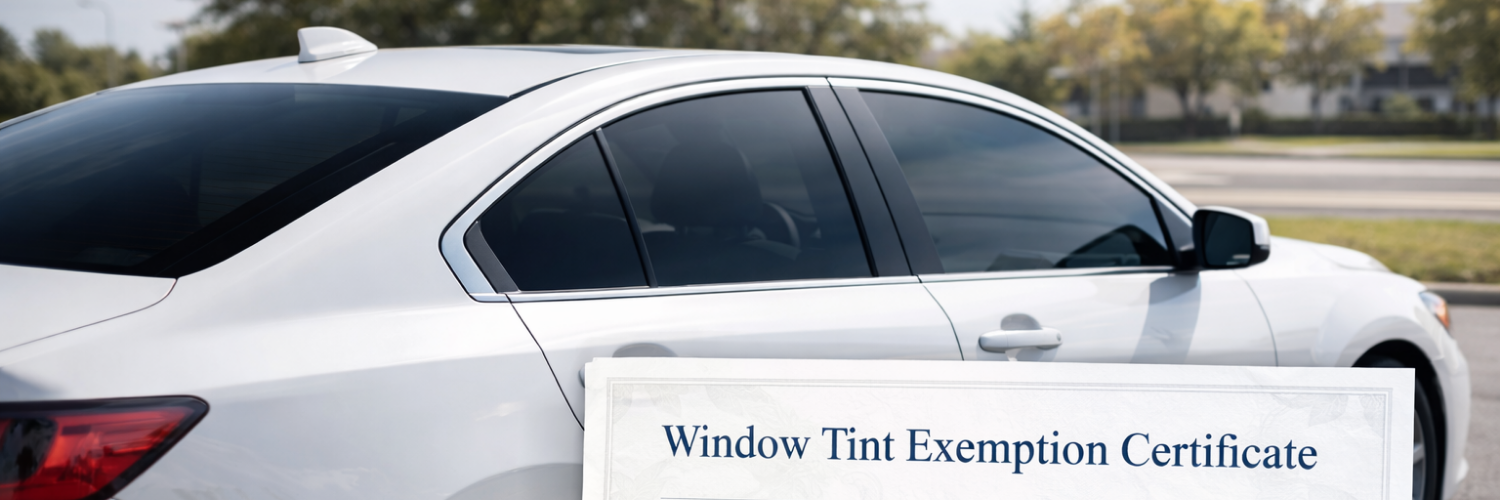
Can You Get a Tint Exemption After a Ticket? Yes, With One Caveat
You can apply at any time, including after a citation, because state medical exemption programs are based on your medical condition rather than on your ticket history. No state statute reviewed here bars a driver from applying after being cited. The caveat is retroactivity: an exemption issued in October does not rewrite what your car looked like in September.
That is why the useful question is not whether you can get the documentation, but what your state’s statute rewards. Some statutes hinge on the driver’s medical need at the time of the violation. Others hinge on whether the driver physically possessed an authorization while driving. The difference decides how much weight late documentation carries in court.
Does a Tint Exemption Apply Retroactively to a Ticket You Already Have?
Usually not in a formal sense, but the statutory wording changes the practical answer. Texas frames its exemption as a defense based on medical need: “It is a defense to prosecution under Subsection (a) that the defendant or a passenger in the vehicle at the time of the violation is required for a medical reason to be shielded from direct rays of the sun,” per Texas Transportation Code 547.613. The element is the medical requirement at the time of the violation, and documentation obtained later is evidence of a condition that already existed.
Virginia writes the opposite kind of rule. A vehicle with tinting film “shall not be operated on any highway unless, while being so operated, the driver or an occupant of the vehicle has in his possession a written authorization” issued by the DMV Commissioner, per Virginia Code 46.2-1053. In a possession state, paperwork dated after the stop does not satisfy the element, though it still shows the court that the condition is real and that the driver is now compliant going forward.
| How your state wrote the rule | Example | What later documentation typically does |
|---|---|---|
| Exemption framed as a medical defense to prosecution | Texas Transportation Code 547.613 | Supports the defense, because the element is medical need at the time of the violation |
| Physician statement carried in the vehicle, no state filing | Ohio, Washington | Helps when the diagnosis predates the citation; the judge weighs it |
| State-issued authorization that must be possessed while driving | Virginia Code 46.2-1053 | Does not cure the past violation, but shows compliance from the issue date forward |
| Agency approval with permit, certificate or decal | Florida, Georgia, New Jersey, North Carolina | Strongest document to hand a judge once issued; processing time matters |
How Courts Tend to Treat a Tint Exemption After a Ticket
Judges are looking for evidence that the medical need is genuine rather than convenient. That is why a tint exemption after a ticket lands better when it arrives with a diagnosis history: prescriptions, dermatology or ophthalmology visit records, or a treatment note that predates the citation. The physician documentation proves the current finding; the older records prove it did not appear the week you were cited.
How Fast Can You Get Documentation Before Your Court Date?
Fast enough in most states, if you start the week you are cited rather than the week of the hearing. ForeverTint’s process runs online: a short questionnaire, purchase, then a chart review by an independent licensed physician, occasionally with a brief phone call, with no video call and no in-person exam. If the physician determines you qualify, signed, state-specific documentation is emailed typically the same day and within 72 hours. Florida documents are mailed because the state requires physical signatures.
Agency-approval states add their own clock. Georgia requires an application to the Department of Public Safety supported by written attestation from a licensed physician or optometrist before the state issues an exemption, per Georgia Code 40-8-73.1, and publishes the form through the Georgia Department of Public Safety. If your state issues a permit or decal, ask the court clerk whether a continuance is available while the application is pending. The full walkthrough is in our guide to how to get a medical exemption for window tint.
What Should You Bring to Court After Getting an Exemption Late?
Bring three things: the physician documentation, anything showing the condition predates the citation, and any state-issued permit or decal paperwork. Present them together, because each answers a different question the judge has.
Be straightforward about the timeline. Telling a judge that you were cited, then had a physician review your condition and now hold documentation is a stronger position than implying the paperwork existed all along. Physician documentation for darker window tint does not guarantee you will not be stopped or cited, and it does not guarantee dismissal. The judge decides, and the same documentation is what you show at the next stop.
According to Derek Anderson at ForeverTint: “The exemption does not undo the ticket, it answers the question the ticket asked.”
Need documentation before a court date that is already on the calendar? Contact Us Today, or start with See If You Qualify.
Will an Exemption Stop the Next Tint Ticket?
Not necessarily. Dark front windows remain visible from outside the car, so an officer can still initiate a stop, and officers retain discretion to cite even when documentation is produced. What changes is what happens next: you hand over a document that state law recognizes instead of explaining a medical condition with nothing to show.
Keep the original in the vehicle at all times, with a photo backup on your phone, and make sure any sticker or decal your state issues is actually applied where the state says. If your state issues a permit with an expiration, renew it before it lapses. And if you are still weighing whether to fight the citation you already have, our guide to how to get a tint ticket dismissed covers the court mechanics, while the background on the paperwork itself is in what a medical window tint exemption is.
Frequently Asked Questions
Can I apply for a medical tint exemption after I was already ticketed?
Yes. State medical exemption programs are based on your condition, not on your citation history, so being ticketed does not disqualify you. Apply as soon as you can, because documentation that exists before your court date is far more useful than documentation that arrives after the case is closed.
Does a tint exemption work retroactively?
Generally no, not in a formal sense. States that frame the exemption as a medical defense look at whether the need existed at the time of the violation, which later documentation can support. States that require you to possess an authorization while driving treat the paperwork as effective from its issue date forward.
Will the judge dismiss my ticket if I bring an exemption I just received?
Possibly, but no outcome can be promised and the judge decides. Bring the physician documentation, any state permit, and records showing the condition predates the citation. Officers and courts retain discretion throughout.
How long does it take to get a tint exemption?
If the physician determines you qualify, ForeverTint emails signed, state-specific documentation typically the same day and within 72 hours after a chart review by an independent licensed physician, occasionally with a brief phone call, with Florida mailed because the state requires physical signatures. States that issue their own permit, certificate or decal add processing time on top of that.
Should I remove my tint while my exemption application is pending?
That depends on your risk tolerance and your state. Until documentation is in the vehicle, the film is simply illegal tint to any officer who sees it, so a second citation is possible. Some drivers remove or lighten the film while waiting; others accept the exposure for a few days and keep driving.
Conclusion
A tint exemption after a ticket is worth pursuing, as long as you understand what it does and does not do. It will not automatically erase a citation, and in states that require you to possess an authorization while driving it applies going forward. It can still carry real weight in court, especially when the diagnosis predates the stop, and it is what lets you keep medically necessary tint in states that allow it. Start now rather than the week of your hearing. Contact Us Today and we will tell you what your state requires.
This article is for general informational purposes and is not legal or medical advice. Physician documentation for darker window tint does not guarantee you will not be stopped or cited; officers retain discretion, and requirements vary by state.