
A tint exemption for skin cancer is one of the most common medical tint requests, and melanoma and other skin cancers are among the conditions physicians most often consider. If you have been treated for a skin cancer, your dermatologist has almost certainly told you to minimize ultraviolet exposure, and the side window next to your left arm is one of the largest uncontrolled exposures in your week. In states that offer a medical exemption, documentation is what turns that medical advice into something your state’s tint law recognizes.
In the states that offer one, a medical window tint exemption is physician-signed documentation stating that a diagnosed condition makes window tint darker than the standard state limit medically necessary. For skin cancer, the relevant condition is not only the tumor you had removed but the ongoing photosensitivity and elevated risk that follow it.
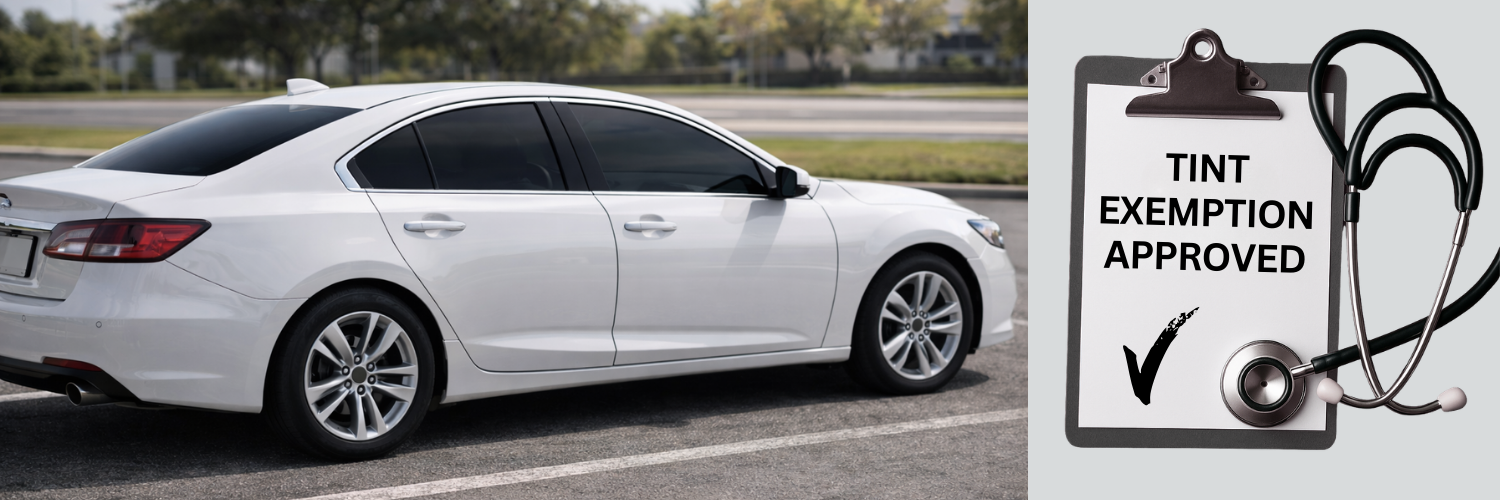
Can You Get a Tint Exemption for Skin Cancer?
In many states, yes, and a documented history of melanoma, basal cell carcinoma or squamous cell carcinoma is among the strongest cases a physician can put in writing. Skin cancer is not a rare diagnosis either. The Skin Cancer Foundation reports that 1 in 5 Americans will develop skin cancer by the age of 70 and that more than 9,500 people in the United States are diagnosed with skin cancer every day.
The Skin Cancer Foundation also notes that having 5 or more sunburns doubles your risk for melanoma, and that when melanoma is detected early the 5-year survival rate is 99 percent. Those two figures together explain why dermatologists push cumulative exposure reduction so hard after a first diagnosis: the disease is highly survivable and highly repeat-prone, and the controllable variable is UV.
According to Derek Anderson at ForeverTint: “Skin cancer survivors are usually the easiest applications a physician reviews, because the patient already has a documented reason to avoid ultraviolet exposure and the car is where they get the most of it.”
Why Does Skin Cancer Show Up More on the Left Side?
Left-side skin cancers cluster because in the United States the driver sits on the left, next to a window that blocks far less ultraviolet light than the windshield does. Researchers at the University of Washington analyzed a federal cancer database and found that 52% of melanomas and 53% of Merkel cell carcinomas occurred on the left side of the body, a pattern consistent with driver-side exposure. The 2011 study was published in the Journal of the American Academy of Dermatology and reported by TIME.
A split that close to even sounds unremarkable until you consider that the human body is symmetrical and there is no biological reason for either side to be favored. The asymmetry points outward, to something environmental, and the most obvious candidate is the hours Americans spend with the left arm, left cheek and left shoulder next to a pane of tempered glass. Our deeper look at why skin cancer shows up more on the left side walks through the driving evidence in full.
How Much UV Reaches You Through a Side Window?
Side windows block far less ultraviolet A light than most drivers assume. A 2016 study in JAMA Ophthalmology measured 29 vehicles from 15 manufacturers and found that front windshields blocked an average of 96% of UVA, with a range of 95 to 98 percent, while side windows blocked only 71% on average, with a range from 44% to 96%. Only 4 of the 29 vehicles tested had side windows blocking more than 90%.
The reason is construction. Windshields are laminated, with a plastic interlayer that absorbs UVA. Side windows are usually single-pane tempered glass with no such layer. UVA is the wavelength range most associated with photoaging and with cumulative skin damage, and it penetrates deeper into the skin than UVB does. Quality window film closes that gap, and even clear UV film blocks most of it, which is the practical argument a physician relies on when documenting a skin cancer patient’s need for sun protection in the car.
Always consult with your healthcare provider about your condition; only a licensed physician can determine whether darker window tint is medically appropriate for you.
Does a Melanoma History Alone Qualify You?
A diagnosis by itself is a strong start, but the physician still has to state medical necessity in writing, and that is the part applicants underestimate. Reviewing agencies are not evaluating whether you had cancer; they are evaluating whether a licensed physician has certified that reduced light transmission is medically appropriate for you now. A pathology report without that sentence does not do the job.
| What the physician documents | Why it matters to a reviewer | What darker tint changes |
|---|---|---|
| Diagnosed skin cancer or precancerous lesions | Establishes the medical basis rather than a preference | Reduces UVA reaching skin inside the cabin |
| Ongoing photosensitivity or elevated recurrence risk | Shows the need is present, not only historical | Lowers cumulative daily exposure on commutes |
| Lesion sites on sun-exposed areas | Connects the diagnosis to driving exposure | Protects the left arm, shoulder and face specifically |
| Expected duration of the need | Determines temporary versus permanent status | Supports multi-year or permanent approval where allowed |
What Should a Doctor Write for a Tint Exemption for Skin Cancer?
The letter should name you, state the skin cancer diagnosis and treatment history, state that darker window tint is medically necessary, identify the signing physician with a license number, and carry a signature and date. States that issue a permit, certificate, sticker or decal usually require their own form and may record an approved VLT level on it. You generally do not need a dermatologist, because most states accept any licensed physician; California’s clear UV film certificate is an exception and must be signed by a licensed dermatologist. If you are weighing several diagnoses, the roundup of medical conditions that qualify for a window tint exemption is a useful cross-check.
How Dark Can Tint Go With a Skin Cancer Exemption?
Where a state allows darker tint for medical reasons, an exemption for skin cancer raises the legal ceiling rather than removing it. Not every state does: California allows only removable sun-screening devices with a physician letter or clear UV film with a dermatologist certificate, Pennsylvania and Kansas allow only clear UV-filtering film, and several states, including Colorado, Hawaii, Iowa, Kentucky, North Dakota, South Dakota and Utah, have no medical exemption at all. Most state programs that grant a darker level stop somewhere in the 20% to 35% visible light transmission range on front side windows, and windshield rules remain strict almost everywhere, usually limited to the strip above the AS-1 line. Visible light transmission, or VLT, is the percentage of light passing through glass and film together, so a lower number means darker glass.
For skin cancer specifically, darkness is not the metric that matters most. Ultraviolet rejection is. Quality films block well over 99% of UV at moderate darkness levels, so a lighter film that meets your state’s limit, with high UV rejection, can protect your skin better than a much darker film with poor specifications. Ask your installer for the film’s published UV rejection figure alongside its VLT rating.
How Fast Can You Get the Documentation?
Online physician review usually takes hours rather than the weeks a traditional dermatology appointment can require. With the Medical Window Tint Exemption Package, you complete a short questionnaire about your diagnosis and your state, and an independent licensed physician reviews your chart, occasionally with a brief phone call. There is no video appointment and no in-person exam.
If you qualify, your documentation is emailed, usually the same day and within 72 hours, and Florida documents are mailed because that state requires physical signatures. If the physician determines you do not qualify, you receive a full refund. Keep the document in your vehicle at all times. For the wider picture, read what a medical window tint exemption is, then See If You Qualify.
Frequently Asked Questions
Does a history of skin cancer qualify for a window tint exemption?
In many states it can, provided a licensed physician documents that ultraviolet exposure remains a risk for you and that reduced light transmission is medically appropriate. Melanoma and other skin cancers are among the conditions physicians most often consider, but rules vary: some states allow only clear UV film or removable sun-screening devices, and some have no medical exemption at all.
Why do more skin cancers appear on the left side of the body?
Because drivers in the United States sit on the left, beside a window that blocks far less ultraviolet light than the windshield. A 2011 University of Washington study published in the Journal of the American Academy of Dermatology found that 52 percent of melanomas and 53 percent of Merkel cell carcinomas occurred on the left side, a pattern consistent with driver-side exposure.
Do car windows protect you from UV rays?
Windshields do far better than side windows. A 2016 study in JAMA Ophthalmology measured 29 vehicles and found windshields blocked an average of 96 percent of UVA while side windows blocked only 71 percent, ranging from 44 percent to 96 percent. Only 4 of the 29 vehicles had side windows blocking more than 90 percent of UVA.
Do you need a dermatologist to sign a tint exemption?
Usually no. Most states accept documentation from any licensed physician, and some also accept an optometrist or ophthalmologist for eye-related conditions. California’s clear UV film certificate is an exception and must come from a licensed dermatologist. What matters is that the signer is licensed in the correct state and that the document contains the diagnosis, a medical necessity statement, a license number, a signature and a date.
Conclusion
A tint exemption for skin cancer sits on unusually firm evidence. Skin cancer affects 1 in 5 Americans by age 70, more melanomas appear on the driver’s side of the body than the passenger side, and side windows block only about 71 percent of UVA on average. If you have a diagnosis behind you, the remaining work is largely administrative: a physician’s medical necessity statement in your state’s required format, for the kind of protection your state allows. Want help figuring out what your state needs? Contact Us Today.
This article is for general informational purposes and is not legal or medical advice. Physician documentation for darker window tint does not guarantee you will not be stopped or cited; officers retain discretion, and requirements vary by state.