
Most drivers assume car glass is a shield. It is not, and the measurements are not close. Researchers who tested 29 vehicles found that front windshields blocked an average of 96% of UVA light while side windows blocked only 71%, which means the amount of UV through car windows that lands on your left arm, left cheek and left hand on an ordinary commute is far higher than almost anyone expects. That gap is the entire scientific argument behind a medical window tint exemption.
This guide covers what the published measurements actually say, why windshields and side windows behave so differently, what long-term exposure through side glass does to skin and eyes, and how window film changes the numbers.
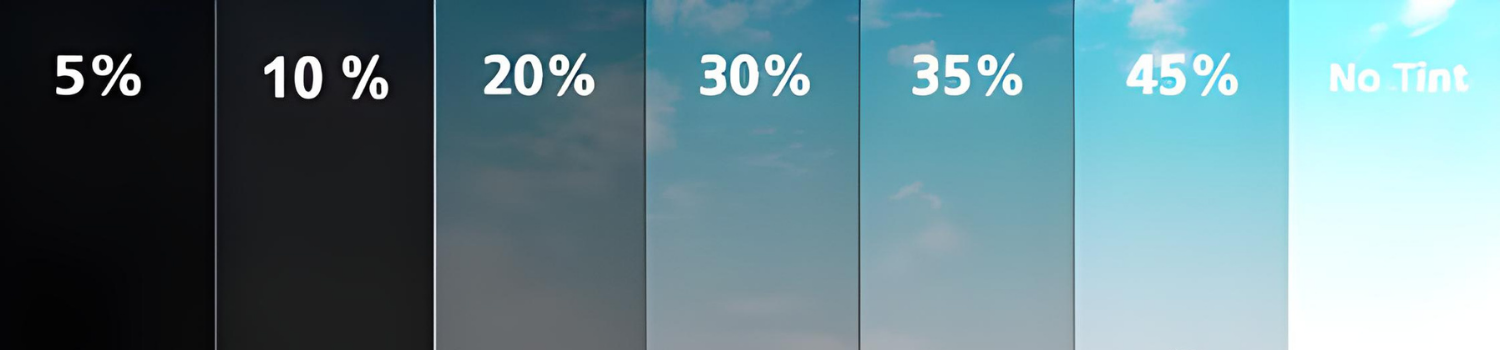
How Much UV Through Car Windows Actually Reaches the Driver?
UV through car windows reaches the driver mostly through the side glass, not the windshield. In a study of 29 vehicles from 15 manufacturers, front windshields blocked an average of 96% of UVA, in a range of 95 to 98 percent, while driver-side windows blocked an average of only 71%, in a range as wide as 44% to 96%. Just 4 of those 29 vehicles had side windows blocking more than 90%. Those figures come from Boxer Wachler’s 2016 study published in JAMA Ophthalmology.
UVA is the long-wavelength part of ultraviolet light that penetrates deep into the skin, drives photoaging, contributes to skin cancer risk, and passes through ordinary glass. UVB, the shorter wavelength that causes sunburn, is almost entirely absorbed by automotive glass. So the sun coming through your side window does not usually burn you. It ages and damages you quietly, which is exactly why people underestimate it.
Windshield vs. Side Window: Where UV Through Car Windows Gets In
| Glass position | Typical construction | Average UVA blocked | Measured range |
|---|---|---|---|
| Front windshield | Laminated safety glass with a plastic interlayer | 96% | 95 to 98 percent |
| Driver and passenger side windows | Tempered glass, no interlayer | 71% | 44% to 96% |
| Side windows with quality UV film added | Tempered glass plus window film | More than 99% | Varies by film |
The windshield and side window figures are from the 2016 JAMA Ophthalmology measurements above. The film figure comes from the Skin Cancer Foundation, which states that UV window film “can block more than 99% of UVA and UVB light” on its UV window film page.
Why Does the Windshield Block More UV Than the Side Windows?
The windshield blocks more UV because it is built differently. Windshields are laminated, meaning two sheets of glass are bonded around a plastic interlayer, and that interlayer absorbs nearly all UVA. Side windows are tempered single-pane glass with no interlayer, chosen because tempered glass shatters into blunt pieces and can be broken out in an emergency. The safety engineering is sound. The UV protection is an accident of construction, and it stops at the A-pillar.
Newer testing says the same thing with newer cars. A 2025 study in Archives of Dermatological Research measured 34 vehicles, 15 gas, 9 hybrid and 10 electric, and found front windshields attenuated an average of 99.25% of UV-A while driver-side windows attenuated 88.78%, a statistically significant gap of 10.47%. UV-B was blocked essentially completely by every window in that sample. Electric vehicles did slightly better at the windshield but showed no advantage at any side window.
Read the two studies together and the pattern holds across a decade of vehicles: the glass in front of you is doing real work, and the glass beside you is not. Ultraviolet exposure in a car is a driver-side problem.
What Does UVA Exposure Through Car Glass Do to Skin and Eyes?
Long-term UVA exposure through car glass shows up as asymmetric damage on the left side of the body in the United States, where drivers sit on the left. In a Surveillance, Epidemiology, and End Results analysis of 82,587 melanomas and 2,384 Merkel cell carcinomas, 52% of melanomas and 53% of Merkel cell carcinomas occurred on the left side of the body, and both cancers were significantly more likely to arise on the left than the right. The University of Washington authors attributed the pattern to driver-side ultraviolet exposure roughly five times stronger on the left arm than the right, in research published in the 2011 Journal of the American Academy of Dermatology and reported by TIME.
The background risk is not small to begin with. The American Academy of Dermatology reports that one in five Americans will develop skin cancer in their lifetime and that approximately 9,500 people in the United States are diagnosed with skin cancer every day, on its skin cancer statistics page updated in March 2026. For eyes, UVA passing through side glass is a recognized aggravator of photophobia, glare sensitivity and eye strain, which is why ophthalmologists were the ones running the 2016 window study in the first place.
Always consult with your healthcare provider about your condition; only a licensed physician can determine whether darker window tint is medically appropriate for you. If you want the deeper breakdown of the left-side pattern, the guide on left side skin cancer from driving walks through the data.
Does Window Tint Block UV, or Does It Just Make the Car Darker?
Quality window film blocks UV independently of how dark it looks. This surprises people, because visible light transmission and ultraviolet rejection are two separate specifications on the same piece of film. A nearly clear film can reject more than 99% of UV, and a very dark film is not automatically better at it. The Skin Cancer Foundation’s Seal of Recommendation for window film requires blocking 99% or more of solar UVA and UVB regardless of tint level.
So why do light-sensitive drivers still want darker film? Because UV is only half the problem. Visible light and glare are what trigger photophobia, glare sensitivity and eye strain, and those come down only when visible light transmission comes down. A driver with a skin cancer history may need the UV number. A driver with photophobia needs the darkness. Many people need both, and that combination is what pushes a request past the state limit.
Those limits exist for a reason. Federal Motor Vehicle Safety Standard 205 requires at least 70% light transmittance in the windows requisite for driving visibility on new passenger cars, and NHTSA has explained the purpose is “to ensure adequate visibility through the windows, thereby reducing the risk of a motor vehicle crash,” in its published interpretation letter. Going darker than your state’s own limit, where the state allows it at all, requires documentation, not a receipt.
Who Should Consider a Medical Exemption Because of UV Through Car Windows?
Drivers with a diagnosed light-sensitive or sun-sensitive condition are the ones a medical window tint exemption is written for. In most states that offer one, a medical window tint exemption is physician-signed documentation that permits tint darker than your state’s standard limit because of a medical condition. Not every state does: Colorado, Hawaii, Iowa, Kansas, Kentucky, North Dakota, South Dakota and Utah have no medical exemption for darker tint, Kansas and Pennsylvania allow only clear UV-filtering film for medical reasons, and California allows only removable sun-screening devices with a physician’s letter or clear UV film with a dermatologist’s certificate. The conditions physicians consider include lupus, photosensitivity dermatitis, melanoma and other skin cancer histories, xeroderma pigmentosum, albinism, porphyria, vitiligo, light-sensitive eye conditions and drug-induced sun sensitivity. The full list is in the guide to medical conditions that qualify for a window tint exemption.
According to Derek Anderson at ForeverTint: “The measurements are the whole argument, because a side window that only stops 71% of UVA is not protecting anybody on a daily commute.”
ForeverTint handles the documentation online. You answer a short questionnaire, See If You Qualify in your state, and an independent licensed physician reviews your chart, occasionally with a brief phone call. There is no video visit and no in-person exam. If you qualify, your documentation is emailed, usually the same day and within 72 hours; in Florida, the physician-signed Form HSMV 83390 is provided to you to submit to the FLHSMV. If the physician determines you do not qualify, you receive a full refund. If you want to talk through your condition first, Contact Us Today.
Frequently Asked Questions
Can you get sunburned through a car window?
Rarely, because automotive glass absorbs almost all UVB, which is the wavelength that causes sunburn. What passes through is UVA, which does not redden the skin quickly but penetrates deeper and contributes to photoaging, pigmentation changes and skin cancer risk over years of driving. The absence of a burn is exactly why the exposure goes unnoticed.
Do tinted windows block UV rays?
Quality window film blocks UV very effectively, and the best films reject more than 99% of UVA and UVB. Ultraviolet rejection is a separate specification from darkness, so a light film can block as much UV as a dark one. Darkness matters for glare and visible light, which is a different problem from ultraviolet exposure.
Which car window lets in the most UV?
The driver and front passenger side windows let in the most, because they are single-pane tempered glass with no plastic interlayer. Published measurements put average UVA blocking for side windows at 71%, compared with 96% for laminated windshields. Rear side windows vary widely depending on whether the vehicle has factory privacy glass.
Does factory privacy glass protect against UV?
Factory privacy glass on SUVs, vans and trucks is darker in appearance but is not designed as a UV barrier, and its performance varies by manufacturer. It also sits on the rear windows, where most states already allow darker glass, so it does nothing for the driver-side exposure that matters most. Front side windows are where the gap is.
Does a medical tint exemption let you block more UV?
Where a state allows it, a medical exemption permits darker visible tint than the standard limit, which mainly helps with glare and visible light. Ultraviolet protection comes from the film’s UV rejection rating rather than its darkness, so a driver can get strong UV protection at any legal tint level. The exemption matters when a physician determines reduced visible light is medically appropriate too.
Conclusion
The measurements settle the argument about UV through car windows: your windshield blocks roughly 96% of UVA and your side windows block roughly 71%, and a decade of follow-up testing has not changed that shape. For most drivers that is a reason to add UV-rejecting film and wear sunscreen on the left arm. For drivers with a diagnosed sun-sensitive or light-sensitive condition, it is the reason a physician may determine that tint darker than the state limit is medically appropriate. Start with the overview of what a medical window tint exemption is, or Contact Us Today with questions about your own situation.
This article is for general informational purposes and is not legal or medical advice. Physician documentation for darker window tint does not guarantee you will not be stopped or cited; officers retain discretion, and requirements vary by state.