
A medical window tint exemption is written physician approval to run window tint darker than your state’s normal limit because of a medical condition. If bright sunlight triggers your migraines, flares your eczema, or leaves your eyes watering on the drive home, that document is what separates you from another tint ticket. Most drivers have never heard of it, and plenty of people who would qualify assume state law leaves them no options at all.
This guide covers what a medical window tint exemption actually is, why the paperwork looks different in every state, who tends to qualify, how the online process works in 2026, and what the document can and cannot do for you during a traffic stop.
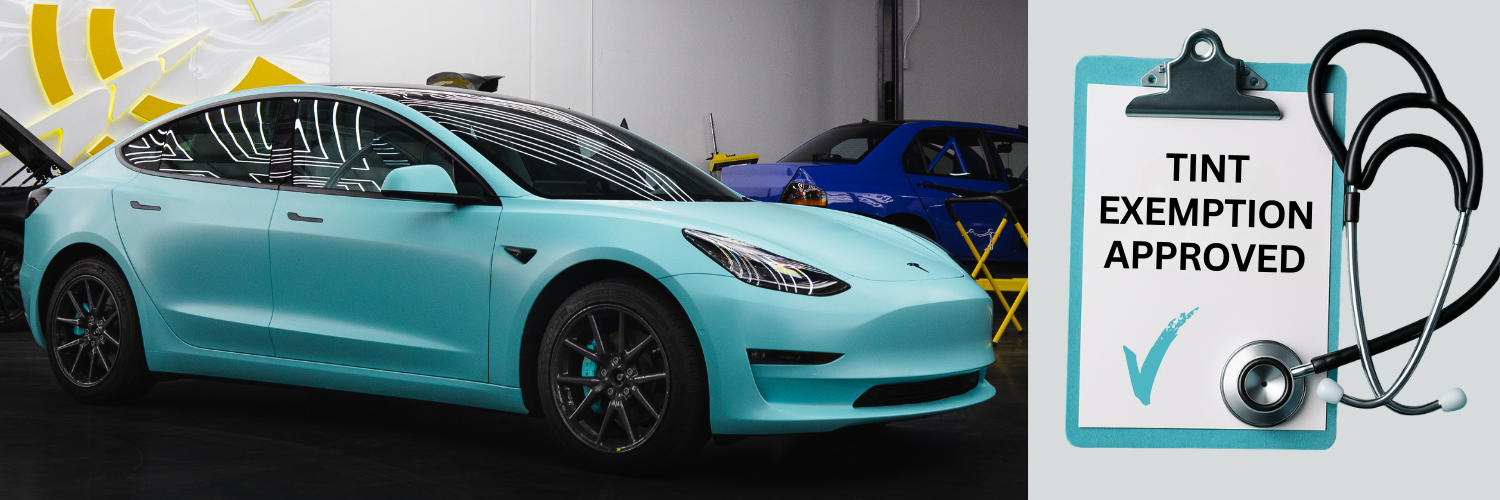
What Is a Medical Window Tint Exemption?
A medical window tint exemption is a physician-signed document that permits a driver to legally use window tint darker than the state’s standard visible light transmission limit because of a diagnosed medical condition. In some states that signed document is the only thing you need, and you keep it in the vehicle. In other states you submit the physician’s paperwork to a state agency and receive a permit, certificate, sticker or decal in return.
The exemption is a written accommodation built into state vehicle codes, not a loophole and not a way around the law. Tint limits exist for a reason. Federal Motor Vehicle Safety Standard 205 requires at least 70% light transmittance in the windows requisite for driving visibility on new passenger cars, and NHTSA has explained that the purpose of the rule is “to ensure adequate visibility through the windows, thereby reducing the risk of a motor vehicle crash,” according to its published interpretation letter. That federal standard binds manufacturers, dealers and repair businesses rather than individual owners, which is exactly why aftermarket tint is governed by 50 separate state laws and why medical exceptions are written into state codes instead of federal ones.
What a Medical Window Tint Exemption Is Not
A medical window tint exemption is not permission to tint as dark as you want. Every state that offers a medical pathway still sets a floor, and some states publish a specific minimum visible light transmission that applies even to approved drivers. The exemption also is not a guarantee against a ticket. Officers retain discretion at the roadside, and the exemption’s real power usually shows up when a driver produces the physician documentation and the citation is reviewed.
How Does a Medical Window Tint Exemption Work?
A medical window tint exemption works in one of three ways, depending entirely on which state registers your vehicle. Roughly 19 states treat the physician’s document as self-sufficient, about 23 states require an agency to review it and issue something in return, and a smaller group has no formal state program at all. Knowing which group your state falls into tells you almost everything about how long the process takes and what you end up carrying.
The Three Ways States Handle a Medical Window Tint Exemption
| Route | What you submit | What you end up with | Example states |
|---|---|---|---|
| Physician documentation only | Nothing is filed with the state | A signed physician letter, statement or affidavit kept in the vehicle | Texas, California, Pennsylvania, Ohio, Washington |
| Physician documentation plus agency approval | The physician’s form or letter goes to a state agency | A permit, certificate, sticker or decal issued by the state | Florida, New Jersey, Georgia, North Carolina, Missouri |
| No formal state program | Nothing is filed, because there is nothing to file | A physician-issued window tint recommendation used as supporting documentation | Colorado, Iowa, Kansas, Utah |
The mechanism matters more than the label. A driver in Texas hands a signed physician statement to an inspection station and keeps it in the glovebox, while a driver in New Jersey mails a completed MVC Sunscreening 1 form to the Motor Vehicle Commission and waits for a mailed authorization. Both drivers have a medical window tint exemption. The route to it is completely different. If you want the breakdown for your own state, the 50-state overview of medical tint exemptions sorts all of them into these three groups.
Who Qualifies for a Medical Window Tint Exemption?
You qualify for a medical window tint exemption when a licensed physician determines that reduced light or reduced sun exposure inside your vehicle is medically appropriate for your condition. The conditions that come up most often are light sensitivity and photophobia, light-triggered migraines, eczema, lupus, rosacea, photosensitivity dermatitis, xeroderma, vitiligo, albinism, porphyria, melanoma and other skin cancers, autoimmune disease, severe burns or scarring, and blurry vision. Drug-induced photosensitivity counts too, and it catches a lot of people by surprise.
The medical logic is straightforward once you look at what actually reaches you through car glass. Researchers measured 29 vehicles from 15 manufacturers and found that front windshields blocked an average of 96% of UVA light, in a range of 95% to 98%, while side windows blocked only 71%, in a range of 44% to 96%. Just 4 of the 29 vehicles had side windows blocking more than 90%. Those figures come from Boxer Wachler’s 2016 study in JAMA Ophthalmology. A driver sitting next to a side window is largely unprotected on that side, which is the whole reason a medical window tint exemption exists.
The long-term pattern lines up with that measurement. In a review of a U.S. federal cancer database, 52% of melanomas and 53% of Merkel cell carcinomas occurred on the left side of the body, consistent with driver-side exposure, in University of Washington research published in the 2011 Journal of the American Academy of Dermatology and reported by TIME. Always consult with your healthcare provider about your condition; only a licensed physician can determine whether darker window tint is medically appropriate for you.
How Do You Get a Medical Tint Exemption Without an In-Person Exam?
You get a medical tint exemption online by completing a short medical questionnaire, purchasing the package for your state, and then having a licensed physician review your chart or verify your history in a brief phone call. There is no video visit and no in-person exam. ForeverTint runs the process this way from start to finish, and the signed, state-specific documentation is emailed the same day in most cases and within 72 hours at the outside. Florida documents are mailed instead, because Florida requires physical signatures.
Four steps is the whole thing. You answer the questionnaire, you See If You Qualify for your state, you complete the Medical Window Tint Exemption Package, and the physician either reviews your chart or calls you for a verification that usually runs 2 to 10 minutes. Company figures for 2026 show that only about 1 in 50 applicants is not approved after physician review, and that more than 20,000 patients have been served to date. If the physician determines you do not qualify, you get a full refund, so the review itself is risk-free.
The physician’s document has to say the right things to hold up, which is where most homemade attempts fall apart. A vague note that mentions sun sensitivity without naming a condition or referencing the state’s tint provision tends to get waved off. The Doctor’s Letter Guide walks through what belongs in the document. Questions about your particular condition or state before you start? Contact Us Today and someone will walk you through it.
How Dark Can You Tint With a Medical Exemption, and Will It Stop a Ticket?
A medical window tint exemption allows darker tint than the standard state limit, but it does not authorize unlimited darkness, and it does not make you immune from being stopped or cited. Several states publish a hard floor for approved drivers, and a few will not approve anything below roughly 20% to 25% visible light transmission no matter what the physician writes. Going darker than your approval covers puts you back outside the law.
Honesty about the traffic stop matters more than a sales pitch here. Physician documentation for darker window tint does not guarantee you will not be stopped or cited, because an officer can write a citation at their own discretion. What the documentation does is give you something substantive to present, both at the roadside and afterward. In the experience of existing customers, drivers who take a citation to court and produce their medical documentation often have the ticket dismissed. Drivers describe that outcome in their own words in the ForeverTint Reviews collected on the site.
According to Derek Anderson at ForeverTint: “A medical window tint exemption does not make you invisible to a traffic stop, it makes your tint defensible, and that is the difference drivers actually feel.”
How Long Does a Medical Window Tint Exemption Last?
How long a medical window tint exemption lasts depends on the state, and the range runs from one year to indefinitely. New Jersey approves its medical exemption for a fixed term, and the state’s own form says that “if approved, medical exemption will be good for 48 months,” with renewal every 48 months, per the MVC Sunscreening 1 form revised in November 2025. Other states have moved the opposite direction and now treat a permanent condition as permanent, issuing certifications with no expiration date at all.
Most other states sit somewhere between those two. Annual recertification, two-year updates, three-year and four-year terms, and physician-determined durations all show up across the 50 states. When your documentation is close to expiring, Tint Exemption Renewals are available in one-year, three-year and ten-year terms with no re-qualification required, which means no second physician consultation. The full state-by-state picture is laid out in the guide on how long a medical tint exemption lasts.
Frequently Asked Questions
Is a medical window tint exemption the same thing as a doctor’s note?
Not exactly. A doctor’s note is the raw physician document, while a medical window tint exemption is the legal status that document creates under your state’s vehicle code. In physician-only states the signed document is effectively the exemption. In states that require agency approval, the doctor’s note is the application material and the state issues the actual exemption as a permit, certificate or sticker.
Do you need a medical window tint exemption for factory privacy glass?
No. Factory privacy glass on SUVs, vans and trucks is usually around 15% to 20% visible light transmission on the rear windows, and it is legal because most states apply looser rules behind the driver. A medical window tint exemption becomes relevant when you want aftermarket film on the front side windows, which is where nearly every state sets a strict limit.
Can you get a medical window tint exemption online?
Yes. A licensed physician can review your medical history and sign state-specific documentation without an office visit, and in most states nothing has to be filed with a government agency at all. The online route typically involves a questionnaire, a short chart review or a brief phone verification, and emailed documentation the same day or within 72 hours.
What happens if you are pulled over before your exemption arrives?
You are treated the same as any driver without documentation, so an officer can cite you for the tint. Once your physician documentation is in hand you have something to present in court, and drivers frequently report that citations are dismissed when they bring the paperwork. The safest approach is to have the documentation completed before the darker film goes on.
Does a medical window tint exemption cover the windshield?
Almost never for the full windshield. Most states only allow tint above the AS-1 line or within the top four to six inches of the windshield, and a medical exemption rarely changes that. The exemption usually applies to the front side windows, which is where standard state limits cause the most trouble for light-sensitive drivers.
Conclusion
A medical window tint exemption is the legal path for drivers whose conditions make ordinary tint limits genuinely hard to live with, and the route to one comes down to which of the three state mechanisms applies to you. Physician documentation carried in the vehicle, physician documentation plus a state-issued permit, or a physician recommendation used as supporting evidence: pick the right lane and the process is usually far shorter than people expect. Most people qualify and simply do not know it. If you want a straight answer about your condition and your state, Contact Us Today.
This article is for general informational purposes and is not legal or medical advice. Physician documentation for darker window tint does not guarantee you will not be stopped or cited; officers retain discretion, and requirements vary by state.