
Every tint law, every tint quote and every traffic stop comes down to one number, so it is worth knowing exactly what is VLT window tint terminology describing. VLT stands for visible light transmission: the percentage of visible light that passes through a vehicle window. A 35% VLT window lets 35% of light through and blocks the other 65%. Lower number, darker window. That single figure is what state statutes regulate and what an officer’s meter reads.
The part that trips people up is that VLT describes the finished window, not the film alone. Your glass already blocks light before any film goes on, so the number on a film box and the number on an officer’s meter are rarely the same.
What Is VLT Window Tint and How Is It Measured?
VLT window tint is measured as the percentage of visible light transmitted through the complete window assembly, glass plus any applied film. Measurement is done with a tint meter, a small device with a calibrated light source on one side of the glass and a photosensor on the other. The meter reports a single percentage, and that percentage is what your state statute compares against its limit.
Two properties get confused with VLT constantly. VLT is about visible light only. Ultraviolet rejection and total solar energy rejection are separate specifications, and a nearly clear film can block almost all ultraviolet light while barely changing VLT at all. The Skin Cancer Foundation notes that UV window film applied to vehicle, home or office windows “can block more than 99% of UVA and UVB light,” and that side, back and sunroof windows are tempered glass, which does not block UVA rays effectively on its own.
What Is VLT Window Tint Versus VLR and Heat Rejection?
On a film spec sheet, VLT, VLR and TSER are three different numbers describing three different things. VLT is visible light transmission, the darkness figure your state regulates. VLR is visible light reflectance, the mirror-like quality that many states cap separately at roughly 20% to 35%. TSER is total solar energy rejected, which covers heat and is what makes ceramic films feel cooler without being darker. A film can be legal on darkness and still be illegal on reflectivity, so read all three.
How Do Glass VLT and Film VLT Combine?
Glass VLT and film VLT combine multiplicatively, so the net VLT of the finished window is approximately the glass percentage multiplied by the film percentage. Apply a 50% film to a window whose glass already measures 70% and the net reading is about 35%, not 50%. That is the single most useful piece of arithmetic in this entire subject, and it is why drivers who buy a film matching their state’s limit still fail a meter test.
| Glass VLT | Film VLT | Approximate net VLT | What this looks like in practice |
|---|---|---|---|
| 88% clear tempered glass | 70% film | About 62% | A light UV and heat film that still reads below a 70% state limit |
| 78% factory tinted glass | 50% film | About 39% | Common factory green glass plus a mid-range film |
| 70% glass | 50% film | About 35% | The example most shops quote, and a typical medical exemption level |
| 70% glass | 35% film | About 25% | Below the standard front-window limit in most states |
| 20% factory privacy glass | 50% film | About 10% | Rear windows on many SUVs and trucks, legal in states with loose rear rules |
Treat those figures as close approximations rather than lab values, since a small amount of light bounces between glass and film. The takeaway holds: ask your installer for the expected net reading on your vehicle, not the number on the film box.
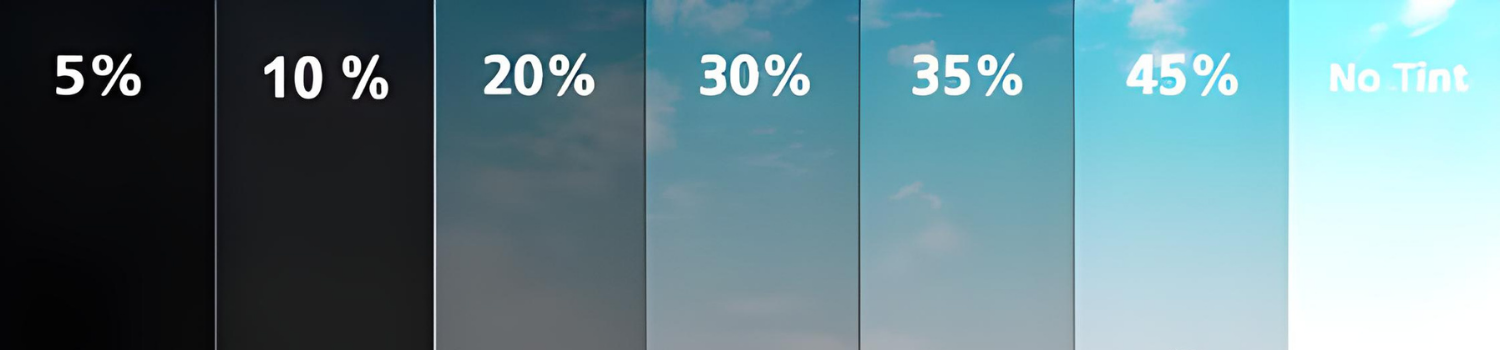
What Does 5%, 20%, 35% or 70% VLT Actually Look Like?
The common VLT grades correspond to recognizable looks. At 70% VLT the window looks essentially clear and is doing mostly ultraviolet and heat work. At 50% the glass looks faintly shaded. At 35% the tint is visible and occupants are still discernible in daylight. At 20% you can make out shapes but not faces easily, which is roughly where factory privacy glass sits. At 5%, often called limo tint, the window is effectively opaque from outside.
Those grades line up with legal reality. Front side window limits run from roughly 20% VLT in the most permissive states up to 70% in states such as California and Pennsylvania, while rear side windows and back glass are unrestricted in many states with two functioning side mirrors. That is why 5% film is legal on the back of a vehicle and illegal on its front doors.
How Do Police Measure VLT With a Tint Meter?
Police measure VLT with a handheld tint meter that reads through the glass and film together, usually on a front side window. Most meters are either a clamshell design that slides over the edge of a partially lowered window or a two-piece design with an emitter and a receiver held on opposite sides. The reading appears as a single percentage within a second or two.
Meters have tolerance, and many agencies allow a few percentage points of margin, but that margin is not a license to run darker than your limit. Dirt, layered film and aging film all shift readings. If you hold a medical exemption, the officer compares the meter reading against the level your documentation supports.
Why Does VLT Matter for a Medical Tint Exemption?
VLT is the unit a medical tint exemption is written in, so the exemption and the film have to speak the same language. Most state programs that grant a darker level stop somewhere in the 20% to 35% VLT range on front side windows, and agency-review states often print the approved VLT figure directly on the permit, certificate or sticker they issue. Install film darker than that figure and the exemption does not cover the difference.
The medical reason for wanting a lower VLT is well documented. A 2016 study in JAMA Ophthalmology measured 29 vehicles from 15 manufacturers and found windshields blocked an average of 96% of UVA light while side windows blocked only 71% on average, in a range of 44% to 96%. Standard side glass is not protective glass.
According to Derek Anderson at ForeverTint: “The number that matters is the net VLT on the glass, because that is what the meter reads and that is what your exemption has to match.” ForeverTint has served more than 20,000 patients with about 1 in 50 applicants not approved after physician review, per company figures for 2026. Always consult with your healthcare provider about your condition; only a licensed physician can determine whether darker window tint is medically appropriate for you.
What VLT Can You Legally Run on Each Window?
Legal VLT depends on window position and on your state, and the windshield is always strictest. Most states allow windshield film only above the AS-1 line, the manufacturer’s mark near the top, or in the top 4 to 6 inches where no AS-1 mark exists. Front side windows carry a published VLT limit, and rear glass is frequently unrestricted with dual side mirrors.
Federal law sets the backdrop rather than the ceiling for owners. FMVSS 205 requires at least 70% light transmittance in windows requisite for driving visibility on new passenger cars, and NHTSA states that the purpose is “to ensure adequate visibility through the windows, thereby reducing the risk of a motor vehicle crash.” That standard binds manufacturers, dealers and repair businesses rather than individual owners, which is why aftermarket VLT limits come from state law. To check yours, See If You Qualify, and for the darkness question specifically read how dark you can tint with a medical exemption or the background in what a medical window tint exemption is.
Frequently Asked Questions
Does a lower VLT number mean darker tint?
Yes. VLT is the percentage of visible light that passes through the window, so a lower number means the window looks darker. A 5% VLT window transmits only 5% of visible light and appears nearly opaque, while a 70% VLT window looks close to clear. State statutes are written as minimums, so a 35% limit means you must transmit at least 35%.
If I buy 35% film, will my window read 35% on a meter?
Usually no, it will read darker. Net VLT is approximately the glass percentage multiplied by the film percentage, so 35% film on glass that already measures 70% produces a net reading near 25%. Ask your installer what net reading to expect on your specific vehicle, because factory glass varies from roughly 70% to 88% on front doors.
How accurate are police tint meters?
Handheld tint meters are accurate to within a few percentage points when clean and calibrated, and many agencies allow a small tolerance before citing. That margin is not something to build on, because dirt, film age and layered film all shift readings. With a medical exemption, the officer compares the reading against the VLT level your documentation supports.
Does VLT tell me how much UV or heat the film blocks?
No. VLT covers visible light only. Ultraviolet rejection and total solar energy rejected are separate numbers on a film spec sheet, and a nearly clear film can block more than 99% of ultraviolet light while barely lowering VLT. Ceramic films are popular for exactly this reason, since they can reject a lot of heat and UV without going very dark.
Conclusion
Once you know what is VLT window tint shorthand for, the rest of the subject becomes readable: visible light transmission is the percentage of light passing through glass and film together, lower means darker, glass VLT and film VLT multiply, and the meter reads the finished window rather than the box the film came in. Getting that number right before installation is what keeps a legal tint job legal, medical exemption or not. Need help matching your state’s limit to the right VLT? Contact Us Today.
This article is for general informational purposes and is not legal or medical advice. Physician documentation for darker window tint does not guarantee you will not be stopped or cited; officers retain discretion, and requirements vary by state.