
If you’re searching for an Oregon DMV Medical Tint Exemption, you may assume the Oregon Driver and Motor Vehicle Services Division (DMV) issues permits for medical window tint. That’s a common misconception. Unlike some states that require drivers to apply through a state agency, Oregon’s medical window tint exemption process is based on documentation provided by a licensed physician or optometrist rather than a DMV-issued permit.
Understanding how Oregon’s exemption process works can save you time and prevent unnecessary confusion. Instead of completing government applications or waiting for state approval, qualifying drivers obtain medical documentation that authorizes darker window tint when additional protection from sunlight is medically necessary.
Does Oregon Issue a Medical Tint Permit?
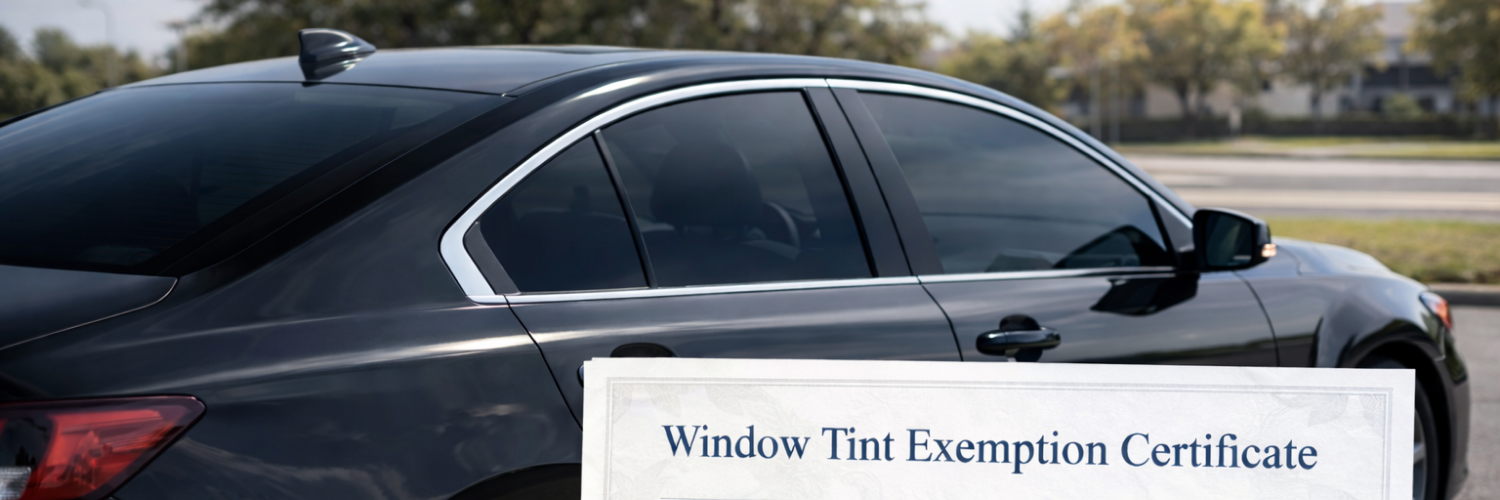
No. Oregon law does not require drivers to obtain a medical window tint permit from the Oregon DMV. Instead, ORS 815.221 allows qualifying individuals to carry medical documentation signed by a licensed physician or optometrist stating that darker window tint is medically necessary because of a qualifying physical condition.
This distinction is important because many online resources incorrectly suggest that drivers must file paperwork with the DMV before installing darker tint. Oregon’s law places the medical determination in the hands of licensed healthcare professionals rather than a state licensing agency.
How Oregon’s Process Differs From Other States
Several states require drivers to submit physician paperwork directly to a state agency before receiving approval for darker window tint. Oregon takes a different approach. Once a licensed physician or optometrist determines that additional sun protection is medically necessary, qualifying documentation may be carried inside the vehicle without obtaining a separate DMV-issued authorization.
This generally makes the process faster while still ensuring that darker window tint is limited to legitimate medical situations.
What Documentation Does Oregon Require?
ORS 815.221 identifies three forms of acceptable medical documentation that may support an Oregon medical window tint exemption. Depending on the medical provider, qualifying documentation may be issued as:
- An affidavit.
- A prescription.
- A letter written on the physician’s or optometrist’s official letterhead.
Each document must establish that the darker window tint is medically necessary because of a qualifying physical condition affecting the individual or another member of the individual’s household. Drivers must keep this documentation inside the vehicle whenever operating with medically exempt darker window tint. The exception covers the side and rear windows of a vehicle registered in your name or your legal guardian’s name.
Why Proper Documentation Is Important

Although Oregon does not issue a DMV permit, the documentation itself serves as your legal proof that your darker window tint is medically authorized. If a law enforcement officer questions your vehicle’s tint during a traffic stop, the documentation demonstrates that your vehicle qualifies under ORS 815.221.
Without proper documentation inside the vehicle, an officer has no immediate way to verify that your darker tint is legally authorized. Even individuals with legitimate medical conditions may receive citations if they cannot produce the required paperwork when requested.
Always Keep Your Documentation With Your Vehicle
Many drivers receive their documentation and accidentally leave it at home or file it away with other records. Oregon law specifically requires that the documentation remain inside the vehicle. Keeping it with your registration and proof of insurance makes it easy to locate whenever needed.
Who Can Issue Oregon Medical Tint Documentation?
Only a licensed physician or licensed optometrist may determine whether darker window tint is medically necessary under Oregon law. The evaluation is based on your individual medical condition, symptoms, and need for additional protection from sunlight or ultraviolet exposure.
Oregon law does not list specific conditions. Conditions a physician may consider include lupus, porphyria, xeroderma pigmentosum, albinism, photosensitivity dermatitis, melanoma and other skin cancers, and light-sensitive eye conditions. Every applicant receives an individual medical evaluation rather than automatic approval.
How ForeverTint Simplifies the Process

Many drivers aren’t sure where to begin when seeking a medical window tint exemption. Finding a physician who understands Oregon’s tint laws can sometimes be difficult, which is why ForeverTint has simplified the process for qualifying Oregon residents.
After purchasing through ForeverTint’s Oregon Medical Window Tint Exemption service, an independent licensed physician reviews your medical history by chart review, occasionally with a brief phone call. During the evaluation, your medical condition is reviewed to determine whether darker window tint is medically appropriate under Oregon law. If you qualify, qualifying documentation is prepared and delivered electronically so it can be printed and kept inside your vehicle.
Benefits of Oregon’s Medical Documentation Process
Oregon’s approach provides qualifying drivers with a straightforward path to obtaining medically necessary darker window tint. Because the law relies on licensed healthcare professionals instead of a state permitting process, drivers can often complete the evaluation much more quickly than they could in states requiring government approval.
Some advantages of Oregon’s medical documentation process include:
- No separate application through the Oregon DMV.
- Medical decisions are made by licensed physicians or optometrists.
- Remote chart review by an independent licensed physician is available through ForeverTint.
- Documentation is delivered electronically if you qualify.
- The process focuses on legitimate medical need instead of unnecessary paperwork.
For drivers living with light-sensitive medical conditions, this process provides a practical way to obtain additional protection while remaining compliant with Oregon law.
Common Misunderstandings About Oregon’s Medical Tint Exemption
Many drivers mistakenly believe they must wait for approval from the Oregon DMV before installing darker window tint. Others assume that simply having a qualifying medical condition automatically exempts them from Oregon’s tint laws. Neither assumption is correct.
Oregon law requires a licensed physician or optometrist to determine whether darker tint is medically necessary and to provide qualifying documentation. Without that documentation inside the vehicle, drivers may still receive citations even if they have a legitimate medical condition.
Another misconception is that once documentation is issued, drivers no longer need to carry it. ORS 815.221 specifically requires that the documentation remain inside the vehicle and be presented to law enforcement if requested.
Stay Compliant With Oregon Law
If your medical condition requires additional protection from sunlight, Oregon law provides a legal way to obtain darker window tint without applying for a DMV-issued permit. The key is obtaining proper documentation from a licensed physician or optometrist and keeping that documentation inside your vehicle whenever you drive.
ForeverTint makes the process simple by connecting Oregon drivers with an independent licensed physician who reviews your medical history by chart review, occasionally with a brief phone call. If you qualify, you’ll receive professionally prepared documentation that complies with ORS 815.221 and can be printed immediately. Learn more by visiting our Oregon Window Tint Exemption page or begin your evaluation through our Oregon Medical Window Tint Exemption service.
Frequently Asked Questions
Do you need to apply with the Oregon DMV for a medical tint exemption?
No. Oregon law does not require a DMV-issued permit for medical window tint exemptions. Instead, qualifying drivers carry signed documentation from a licensed physician or optometrist supporting the medical need for darker window tint.
Who issues an Oregon medical window tint exemption?
A licensed physician or licensed optometrist determines whether darker window tint is medically necessary. If you qualify, they provide qualifying documentation that satisfies the requirements of ORS 815.221.
What documents are accepted under Oregon law?
ORS 815.221 allows an affidavit, prescription, or letter written on official physician or optometrist letterhead. Each document must confirm that darker window tint is medically necessary because of a qualifying physical condition.
Do I need to keep the documentation inside my vehicle?
Yes. Oregon law requires qualifying documentation to remain inside the vehicle whenever you are operating with medically exempt window tint. Law enforcement may request to review it during a traffic stop.
Can I receive a citation if I don’t have my documentation with me?
Yes. Without your qualifying medical documentation, law enforcement may have no way to verify that your darker window tint is legally authorized. Keeping the paperwork inside your vehicle helps avoid unnecessary complications.
Does ForeverTint provide the required Oregon documentation?
ForeverTint connects Oregon drivers with an independent licensed physician who performs an individual medical evaluation. If you qualify, qualifying documentation is prepared and delivered electronically for you to print and keep inside your vehicle.
How long does the process usually take?
The process is designed to be convenient. After purchase, an independent licensed physician reviews your medical history by chart review, occasionally with a brief phone call, and if you qualify, the signed document is emailed to you to print and keep in your vehicle.

